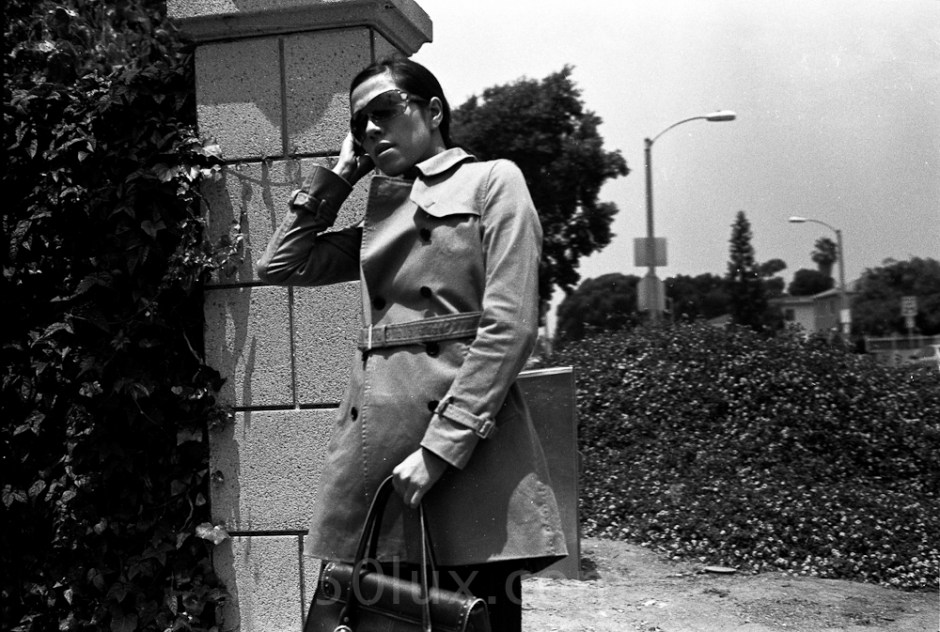
Mysterious young woman, augmented by gesture, sunglasses, a raincoat, and the most iconic film since Kodachrome.
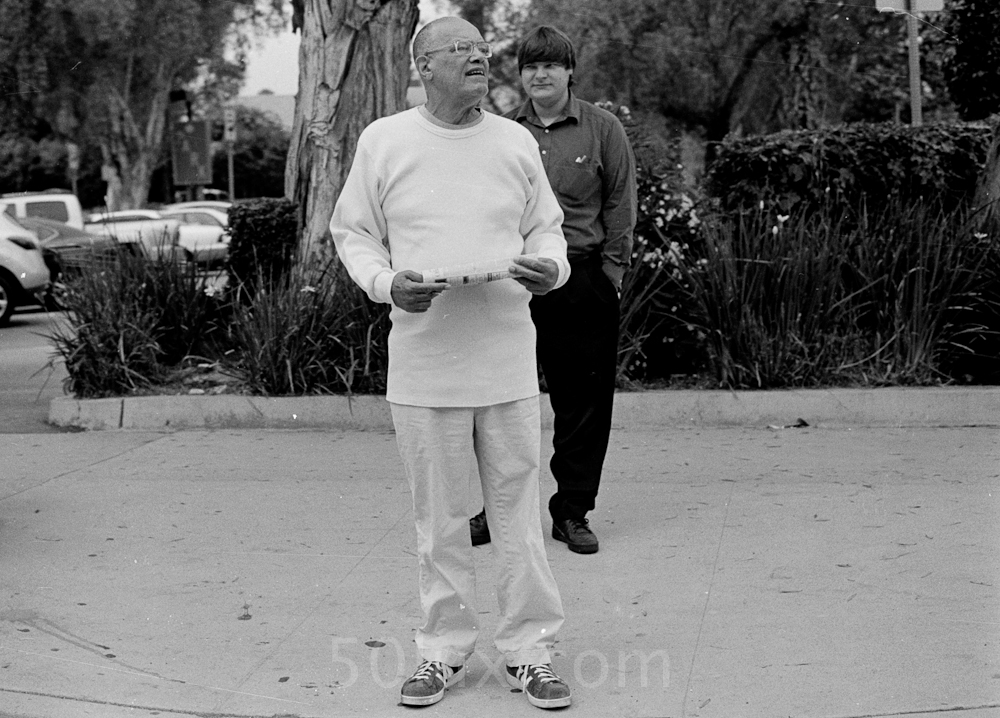
No comment. 😉
Mysterious young woman, augmented by gesture, sunglasses, a raincoat, and the most iconic film since Kodachrome.
No comment. 😉

“I think it pisses God off when you walk by the color purple in a field and don’t notice it.” – ‘Shug’ Avery in The Color Purple by Alice Walker
(Originally published on stevehuffphoto.com – July 2011. Feels appropriate for another blistering July.)
I-15, the highway to and from Las Vegas, is traveled by an endless caravan of Southern Californians every year, alternately speeding and crawling their way to Sin City to pass the hours into weekends throwing money away in smoky casinos. With the disposable income gone and the pool parties over, the line of cars moving back through the desert to Los Angeles is most impressive in the sheer single-minded execution of its purpose. Eyes fixed (we can only hope) on the road ahead, it’s pretty clear that everyone just wants to get home.
The setting of this perpetual movement of cars and people is what calls to mind The Color Purple thought quoted above. More on that setting in a second.

But first, does God really get pissed off when we pass by the color purple without noticing? For an athe-nostic like me, the question would go more like this: if nature has created something spectacular to behold, what does it say about us if we routinely pass by it all with our eyes squarely focused on the road ahead, our perspectives blinkered by our desire to simply get someplace else?
Whether it’s an angry God watching down on us or the collective guilt of too few of us, given the sheer magnitude of both the transgression and the number of souls involved, the 270-mile drive between Las Vegas and Los Angeles — through the Cajon pass and over the Mojave Desert — would surely amount to something of a worst-case-scenario for someone as thoughtful about such things as the fictional Suge Avery.
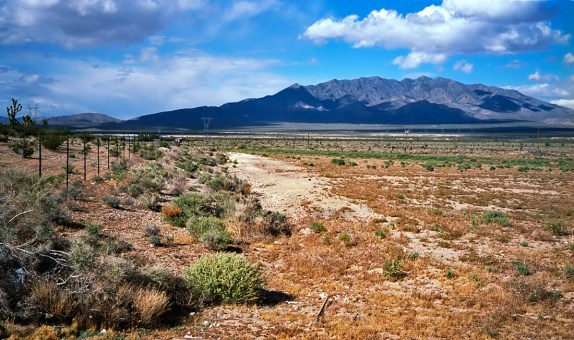
The vast empty expanse of the high desert alone has a visual silence that borders on the metaphysical. One turn of the head and the eye takes in endless vistas completely absent the presence of humans. Appropriately miniscule in scale, the only people to be found are contained in the narrow band of highway snaking through the midst of a truly timeless landscape.

Drivers blow through the desert as fast as they can. Except for a few small towns, there’s only a smattering of rest areas along the way and the occasional supersized gas stations. With nothing really for hundreds of miles but great scenery, it would be difficult for anyone inclined to deviate from the beeline of automobiles to actually do so.
We take the drive ourselves just about every year, always in the winter or late spring. There’s usually weather off in the distance and sometimes we run right into it. We stop occasionally at one of the rest areas for 10 minutes or so, in a hurry, like everyone else. There’s a wind that seems to live at those huge gas stations that can’t in good conscience be called a breeze and, while the cold smack of it after two hours on the road is exhilarating, it always feels really good to get back in the car.
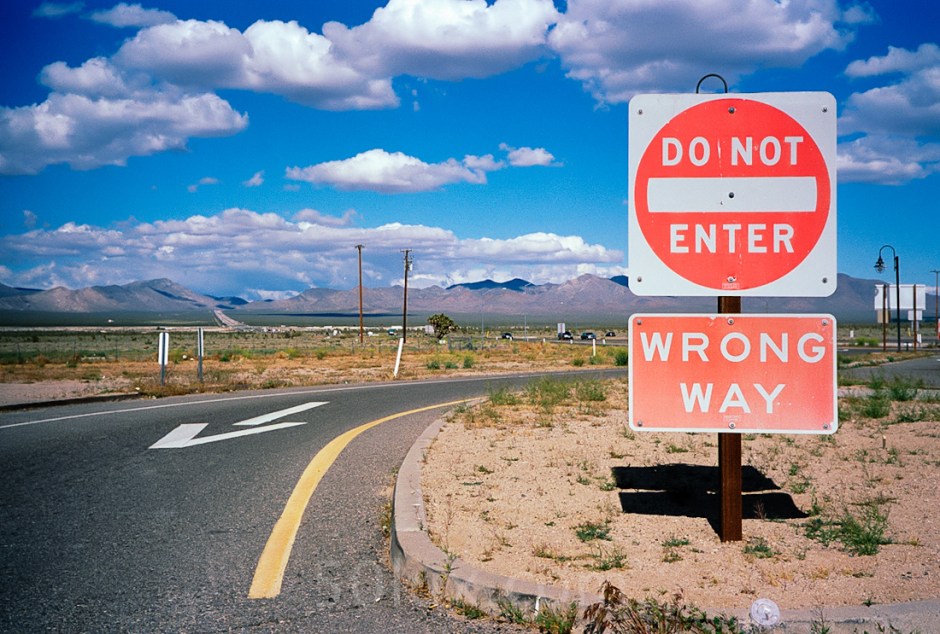

There were the familiar clouds, rain, even thunder, and snow on the ground in the mountain passes, but this time driving through the higher altitudes there was the disorienting sight of even more ominous looking clouds lying in the valleys far below the highway. There was sunshine, maybe mostly sunshine and, of course, the wind. Not surprisingly the air smells like desert and I guess to recall the old vent windows in cars from my childhood, I like to open my driver’s side glass just a crack to hear the whistle of the wind as I drive.
Maybe it’s too much of the things we did back in the seventies, but my imagination plays in the flat desert and hills there in the wide panorama shot. I’d like to hire a helicopter and tell the pilot to set down in the hills underneath the clouds in the left part of the image, get out, take pictures for a while, breathing in the desert, then point to a sun-drenched valley in the distance and say, “Okay, let’s go over there.”

I’m not a natural scenery shooter and I think the snapshots presented here will attest to that. I hesitate to add that the Leica M system of cameras is said not to be well-suited for landscape photography. The hesitation is because the M7 was more than adequate given my capabilities.
I hope these shots from the California high desert find you in a place and time where you can take notice of its incredible beauty. With most of the country sweltering in a mid-July heat wave it would be wonderful if this article even briefly transports some of you to the brisk springtime captured in the photographs here. If you try, you just might hear the wind whistling at my car window and imagine for a moment the cold desert air in your face.

Remember, God may be watching. Personally, I don’t think so, but I’ve been wrong before and these shots and this piece amount to my own personal penance just in case.
All the images taken with a Leica M7, Voigtlander Nokton Classic 40mm 1.4, and Kodak Portra 160 VC.
db


Sometimes the message gets lost in the flow and crush of humanity. Click on the image for a larger version.


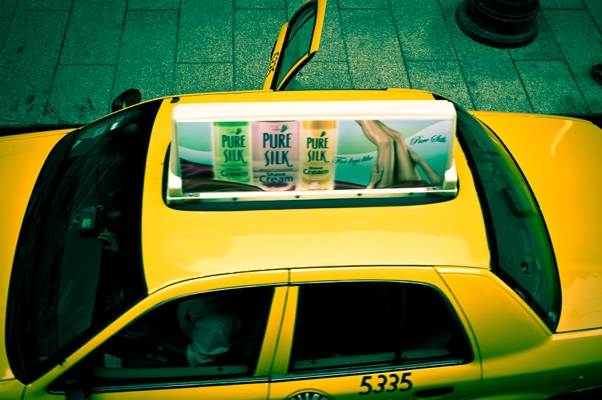
Some pictures from a trip to Chicago a few years ago. It was my first chance, really, to use the Leica M9. Ah memories. With the 35 Summarit 2.5.

 50'Lux