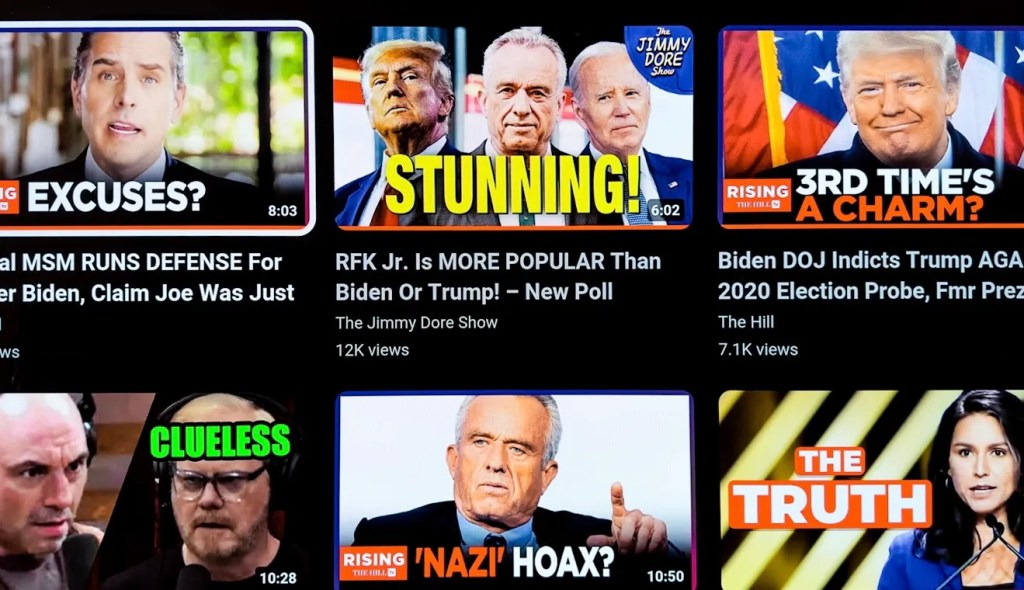
So, I’ve decided to write this piece to expose, I hope to a great extent, a serious issue I’m having with this now essential, possibly democracy saving, new form of political journalism that I myself love and depend on to provide my heart and mind with the hope that at least someone with a bigger platform than my own is seeing what’s happening in the world as I see it.
And that hope was truly reinvigorated over the last five years upon discovering that so many bright well-educated young people are of much the same mind regarding our current cultural and political challenges as this old dude.
I’m referring, of course, to those now suddenly never-more important outside-the-mainstream independent media voices that initially coalesced around podcasting, moved on to the slick studio-based news and political analysis programing we see daily on YouTube and other streaming platforms, as well as the many who have found a home here on Substack.
One thing that has been a constant and oh-so-true refrain on indie media for the entirety of its existence is that the mainstream establishment press isn’t reporting on so many stories that have great importance to the public. Who could put a number on how many times we’ve heard that complaint coming from the hosts of Rising or Breaking Points or from Joe Rogan, Glenn Greenwald, or Russell Brand?
And that’s essentially why we watch and listen to these voices and why they even exist in the first place. It’s why they are necessary. They’re filling a void. The very existence of that void represents an egregious failure. It shouldn’t be there. The mainstream news media should be telling the stories we see every day on the independents. But, almost invariably, it is only on indie media that such stories are brought before the public.
I’m just going to leave that thought out there with the hope that it will continue to resonate for the remainder of this piece.
One such story, likely the most important story any journalist alive at this historic moment will ever cover, is the almost exclusively journalistic pursuit of the truth about the origins of the COVID-19 pandemic.
I say almost because there are efforts being made in the United States Senate by the Republican minority. But heretofore it’s really been only independent journalists, along with a smattering of scientific researchers, doggedly working their way through documentary evidence, that has brought us closer than we’ve ever been to knowing how a novel coronavirus first infected humans in Wuhan, China, a truly cataclysmic event that led to millions of lives being lost around the world.
Out in that very real world, millions died from the virus, leaving behind tens of millions more permanently traumatized by what happened to their families over the last four years. But it is my observation, potentially flawed as it may be, that we’re not hearing from those people. Their tragic first-hand coronavirus stories are not, as far as I can tell, being widely shared with the public.
So it is my most sincere hope for this particular piece that I’m able to impress upon the devoted journalists and scientists pursuing the lab leak story, and anyone else for that matter, that they should look at the continuing public conversation about the lab leak and really all things relating to the pandemic and notice that there is one thing glaringly absent from the conversation: That would be the voices of those who have actually lost family to the coronavirus, their stories, their tragic details, giving first-hand accounts of the trauma visited upon them and their loved ones by this most awful, and most likely man-made, human catastrophe.
Almost two weeks ago I posted a piece here on Substack telling of one such family’s experience with COVID. It was the story of my own wife’s family; her brothers and sisters as well as one nephew.
But the piece I published, ‘Let the Inquisition Begin’ isn’t just a story of COVID hitting some people, it’s a story of COVID hitting certain people, a certain type and class of Americans who aren’t really on the radar of either the prestige legacy media or even the indie voices who appear to share with their mainstream counterparts an economic and educational background that stands very far apart from the kind of people who typically live in the regions of the country where my wife, her family, and I all come from.
My piece is the story of what happened when a lab-engineered supervirus hit one Western Pennsylvania family. And, as such, it’s also very much a story about COVID hitting a family in the context of that family’s socio-economic positioning in America and, also, to their tragic detriment, their place on the world stage of events.
How our family reacted to everyone suddenly coming down with COVID maybe speaks to how so many Americans reacted to coming down with COVID and why there was a disproportionate amount of more severe cases and deaths the further down in class victims of the virus happened to be.
But my piece is also a story of the many working-class eccentricities of Americans living outside the coastal enclaves of the highly educated and generationally affluent and how those eccentricities played into the outcomes that were more likely to be experienced by such Americans.
Interesting stuff, no? They used to call these human-interest stories. I’m not sure if they still do. They’ve been an essential part of the journalistic tradition forever. They bring often tragic personal stories home to readers in such ways that people can more easily relate to. They have an emotional impact that mere factual reporting most often doesn’t.
These are all things that are contained in my piece. Some of it is overtly addressed and some of it is written between the lines. And some is probably just baked into my writing without me even knowing it due to my voice being that of a person who comes from that very same background. These are the things that make my piece important and, as incredible as this seems to me with upwards of 10 million dead worldwide, more than just a little bit rare at this moment.
But these are the kinds of things I would be talking about, if anyone in the media was actually talking to me about my piece.
Today, whenever someone is unjustly killed, murdered in a criminal act, or by an act of negligence, or by accidents that just shouldn’t have happened, even just one single human being, we might hear about that death on the news for years. Then that single solitary death might be deemed a historically important event and be recorded as such and thus live forever as a political touchstone.
The lead story on one of the 10 PM news broadcasts here in LA the week prior to me publishing my piece was of demonstrations calling for justice in the absolutely unacceptable police shooting of a Trader Joe’s worker that happened after a gunman entered the store in which she was working. It was a terrible and unnecessary taking of a much-loved young woman’s life. But it happened five years ago. Just one death. And yet here it was opening the 10 PM news broadcast in Los Angeles five years later.
And that’s fine. It really is. But the thing is, in contrast, we’re not hearing at all from families who suffered the worst outcomes of a pandemic that very well might have killed upwards of 10 million people worldwide. Are we? My sincere answer to that question is that we are not, but if I’m wrong about that please, someone, show me those stories.
There’s no question that a major factor in the dearth of stories coming from families who suffered the worst outcomes during the pandemic is that the general public, by and large, especially the part of the public that isn’t watching independent media on YouTube or reading Substack newsletters, is unaware of how convincing the evidence has become that the virus was the result of both gain of function research and an accidental lab leak.
And even though a recent poll shows that two thirds of the American public believe a lab leak to be the most likely cause of the coronavirus pandemic, we’re still a long way from anything that looks like a firm confirmation of that likelihood being delivered to and processed for what it is by the citizens of this country and the rest of the world.
So if a significant percentage of Americans are still ambivalent about the origin of the virus, if there’s no breaking news confirmation of the lab leak theory on their broadcast network television screens, something that appears unlikely under any foreseeable circumstances, and they’re looking at the pandemic as a terrible, once in a century act of nature, then I will admit there’s not going to be much of a market for stories of people’s families getting sick with what the mainstream media has consistently and quite rigidly maintained was a completely naturally occurring virus.
It’s only the looming possibility of COVID-19 having come from dangerous scientific research and a disastrous accidental lab leak that supercharges the millions of tragic individual stories that can be told from around the world of the destruction of lives that occurred as a result of government funded scientific research gone horribly wrong.
Thus the piece on my wife’s family’s devastating encounter with the coronavirus has turned into almost an unintentional scientific experiment of its own. Where does this story go? How far? Does it just die on my Substack page with pretty much no one having read it? It seems at this point that that’s where things are going. Or will my wife’s family’s story be carried to a wider audience?
Are any of the conversations happening around these matters even now being carried to wider audiences? I’m referring to the daily coverage and analysis on indie media of the many COVID controversies over vaccines, lockdowns, and, of course, the highly polarizing journalistic pursuit of the true origins of the virus.
It seems to me that all of these subjects and the discussions surrounding them are, at this point, occurring only between a few thousand people, if that, largely on social or new media platforms that the vast majority of the human race doesn’t interact with.
How do we get these stories in front of a wider audience? What happens if we are unable to? At what point do even people with powerful voices and important stories to tell simply give up?
I find myself grappling with those questions a lot lately. If virtually no one is reading my pieces, if they’re not even being shared by the like-minded, how much longer will I continue to do this?
At this point it would seem to me that everyone is part of the control mechanisms of who gets heard in society. Not just the government or social media platforms overtly trying to limit and control free speech. It’s even fellow travelers. It’s even those working in the areas of uncovering the truths about the pandemic and those directly fighting the government and corporate efforts to censor the voices of the American people.
Everyone is now a part of the determining of whose voices are heard in society. This is now an unavoidable modern-day reality that’s part of the inherent feature set of the mostly social media platforms we’re all using to interact with each other.
As of this writing, it looks like 144 people have read my Inquisition piece here on Substack.
Some of the more important voices on this platform have hundreds of thousands of subscribers and collectively millions of followers on Twitter. Just one retweet from any of the indie media accounts I tagged when I first published my piece almost two weeks ago and thousands would have already read the story of what happened to my wife’s family.
Everything that the independent media is doing on the subject of the COVID-19 lab leak story and most every other subject they cover is about telling people what happened. That’s what they do. And I’m sure, that by telling people what happened, they’re hoping that people will then demand better from those in power.
What the independent media is all about is getting a response from the public. Is it not?
I’m certainly no different. I’m not writing pieces on Substack for my own enjoyment. I’m writing them because I want them to be read, I want my voice to be heard, and I want to have an impact on the issues that I believe matter most to the American public. I’m that old dude.
And from what I can see, I’m no different, in that respect, than those who make up the independent media. I think we’re all trying to accomplish the same things.
The quality of work and analysis coming from this relatively tiny group of individuals who make up the independent left media is I believe unmatched in my lifetime. In comparison, I’m just a grumpy voice coming from the back row where I belong. But all of our voices are badly needed right now, maybe like never before in the history of this country.
I don’t worry about the sincerity and commitment of the independent media voices I follow and support. It does however seem to me to be a bit of a clubby closed group with a lot of people competing for the attention of a limited segment of the public and any rewards that might bring.
I would strongly suggest to those who make up the independent media that they should more readily embrace voices coming from the general public who make the kinds of serious efforts I’ve made as well as so many others.
They must be seeking an impassioned response from the public as they produce their badly needed journalistic work. Things only change when there is such a response from the public. My pieces here on Substack are a part of that response.
Please help make sure that our voices from the back row are being heard, too.
 50'Lux