JFK

Kennedy Girls: RFK Jr.’s pursuit of the Democratic nomination hits home

In 1999, the local newspaper in Beaver County, Pennsylvania asked for letters from readers giving their thoughts or reflections in recognition of Black History Month. I submitted the following. It opens by referencing a letter I’d written to the same paper the previous year.

Last year, in response to a series of articles in this newspaper addressing the various issues involving race and racism in Beaver County, I wrote a letter to the Times in which I stated that I wasn’t taught racism by my parents. While that statement is true, it is, of course, not that simple. I don’t recall, for instance, my father ever speaking badly of black people. But then he never, as far as I can remember, said anything at all to me about race or the problems of racism in America. My mother, on the other hand, was born and raised in Alabama and more than anything else it is the stories she told of the injustices she witnessed, first in the south but also later in Pennsylvania, that forever shaped my own views regarding matters of race.

Thanks for reading The Lost Democrat! Subscribe for free to receive new posts and support my work.

I want to share two of these stories with the people of Beaver County, certainly in recognition of Black History month, but moreover because of the effect that these stories have had on me; in helping to form my own understanding of the ways in which America has so often failed to honor its promise of equality and justice, and the ways in which so many Americans have dishonored their country’s legacy, infusing it with a history of violence and oppression. 

It’s important to note that the racism my mother witnessed and relayed to me was not the vague disquieting negativity that is, sadly, something seemingly intrinsic in varying degrees to all of us, black and white. My mother’s stories were of overt acts, vivid examples of the outrageous and indefensible social crashes that developed from and were legitimized by the culture of mistrust and hatred that has existed for centuries in America. They are stories told from a perspective that is not often heard on the subject of profound racial injustice: that of a white person who was there and who is not socially or psychologically constrained from bearing witness. And, of course, these are the accounts that have been traditionally left out of official records and newspapers. They are alternative views of events in a historical era that one is not likely to find in history books.  

The most extraordinary of my mother’s stories occurred in Augusta, GA immediately after World War II. My father had been injured in Europe and was convalescing in Oliver General Hospital, adjacent to the same golf course which now, ironically, hosts the prestigious event that Tiger Woods’s name will always be synonymous with, The Masters Tournament. 

My mother was having lunch in a coffee shop in downtown Augusta when a black window-washer fell from his scaffold to the pavement below, just outside the restaurant’s window. A crowd, which included my mother, formed around the critically injured man and an ambulance was summoned. But when the ambulance arrived, those in charge refused to transport the injured man to a hospital. The ambulance, it seems, was for whites only. A black ambulance would have to be called. My mother, having spent a number of years in the north, was outraged and pleaded for the immediate transport of the fallen window-washer. “If I take him in this ambulance,” the driver explained to her, “no white person will ever ride in it again.”  

By my mother’s account the window washer would have died anyway, no matter what medical procedures were taken to save him but, incredibly, he died there on the sidewalk with no medical attention being administered whatsoever. And the story does not end there. In Augusta, small city that it was, news of my mother’s behavior traveled fast. Just hours after the tragedy she was informed by the owner of the boarding house where she was staying that she would have to find someplace else to live. “We don’t coddle our n—— around here,” she was told.

This was the south before African Americans effectively organized themselves, fought for and won the civil rights that most of white America in those days seemed quite comfortable denying them. But another story that my mother told took place in our own Beaver County, during the early 1960’s. And although not of the tragic magnitude of the window-washer’s outrageous treatment, it may be, due to the local political environment in which it takes place, a more useful example of manifest systemic racism.

In 1960, during John F. Kennedy’s presidential campaign, my mother was a close friend of this region’s state senator. Due in part to this association and due in part to the fact that my mother founded and held the charter to an organization called The Democratic Women of Greater Aliquippa, the senator assigned her the privilege of choosing Aliquippa’s Kennedy Girl. The Kennedy Girl concept was a campaign gimmick wherein teenagers from individual communities were chosen and presented solely for the purpose of creating a buzz of local publicity for the decidedly un-local Senator Kennedy. In the process of choosing the right teenager, my mother recalled one girl in particular whose singing and stage presence at a Democratic Party banquet had impressed both her and the state senator. And so, with the state senator ‘s full blessing, my mother chose a black girl from Aliquippa to be the town’s representative young person.

A group photo shoot featuring all of the local Kennedy Girls was scheduled for 9:00 AM one morning at the old Beaver Valley Tribune with pictures in the newspaper to follow shortly thereafter. In the days preceding the shoot, my mother began receiving phone calls from two prominent Beaver County democrats imploring her to reconsider her choice for Aliquippa’s Kennedy Girl. Each of the two elected officials had, it seems, chosen his own daughter for the distinction and both openly voiced the objection that they did not want their daughters to be photographed with the black girl. My mother argued that Kennedy needed the support of the area’s black voters, but she was told that the black vote in Beaver County was so minute as to be insignificant. Without painting an overly complimentary picture of my own mother, let me simply state that she did not alter her selection as requested by the two gentlemen.

On the morning of the shoot, my mother and the young lady took the drive to Beaver Falls for what they both assumed would be quite a moment for the local girl. But even after arriving at the newspaper twenty minutes early they were informed that they had come too late; the scheduled time of the photo shoot had been moved up from 9:00 AM to 8:00 AM and the photographs had already been taken. The other Kennedy Girls and their sponsors were gone. Of course there were tears on the part of the teenager from Aliquippa. One can only imagine what she must have thought at that point about white people or Democrats or even about my mother, who had naively set in motion the series of events that had resulted in her rejection.

The promise of fairness and equality prevailing above all else in America has existed ever since the founding of our nation. Yet today, just as in the window washer’s day, millions of black Americans can still claim access to only limited health care resources. How many die each year because they don’t receive proper medical treatment or procedures that are unavailable to them is anybody’s guess. And today, just as in the days of Kennedy Girls, most young black people in this country continue to be turned off at the local level by a political process that could and should enable and empower them to positively effect their own lives.

One can’t help but wonder what Aliquippa’s Kennedy Girl must have been thinking when the president she attempted to publicly support said, in his 1963 televised address on the issue of civil rights, that “The time has come for this nation to fulfill its promise.” President Kennedy’s words speak specifically to the covenant of equality that we as a nation so often take for granted. And they yet endure as a blunt challenge to all Americans.

The Piss-Colored Journalism of the New York Times: The newspaper’s jaundiced and dishonest take on Robert F. Kennedy’s big day

Scrolling through the articles on the NYTimes app it was impossible to find the newspaper of record’s coverage of Robert F. Kennedy Jr.’s announcement that he will be seeking the Democratic Party’s nomination in 2024. There’s a very good reason for that. It wasn’t there. A piece reporting on the fact that a member of the nation’s most storied political family was once again running for president didn’t rate the same visibility on the Times’ app as features with titles like “What Would You Do for a Taylor Swift Sweatshirt?” and “An A.I. Hit of Fake ‘Drake’ and ‘The Weeknd’ Rattles the Music World.” 

It wasn’t until I came across a tweet on my Twitter app that I was led to the Times’ article on Kennedy’s announcement and the event that was held at a ballroom in Boston’s Park Plaza Hotel.

I’d woken up to the speech. Literally. When I groggily picked up my phone and clicked on Twitter I saw the event being broadcast (not sure broadcast is the right word for it) on Twitter Spaces and caught the entire speech, with the exception of a few momentary glitches, from start to finish. 

To say that the Times’ piece, written by Trip Gabriel, the newspaper’s former editor of the Sunday paper’s “Styles” section, did not reflect the speech I’d heard RFK Jr. deliver would be an understatement worthy of, well, the New York Times’ own penchant for slanting the news and burying important story angles behind walls of misinformation. Gabriel dismissed the event as being a gathering of those with a “shared skepticism about vaccines and the pharmaceutical industry.”

“Mr. Kennedy is the latest in a history of fringe presidential aspirants from both parties who run to bring attention to a cause, or to themselves.” 

That statement is as stunningly off key and out of tempo with the era we’re living in as anything I’ve ever read in the Times. The journalist who revitalized the paper’s Sunday Style section “into a multifaceted presentation of fashion, lifestyle, entertainment and celebrity news” continues:

“For Mr. Kennedy, that cause is vaccine skepticism… at the height of the Covid-19 pandemic, he sought to undermine public trust in vaccines.” 

Gabriel states that “Both Facebook and Instagram took down accounts of a group he [Kennedy] runs for spreading medical misinformation.”

First off, it’s hard to read the perspective presented by Mr. Gabriel and reconcile it with the calendar. It’s now 2023. Skepticism of Covid-19 vaccines is a widespread feature of the American political landscape. 

Skepticism of Covid-19 vaccines exists primarily because of the myriad instances of the American people being presented with false and misleading TRUE AND ACTUAL medical misinformation, fed to us by our government, its national health care apparatus, and the establishment news media. Whether it was about efficacy or the prevention of transmission of the virus, medical misinformation told to the public about the vaccines was a feature and not a bug throughout the Covid-19 pandemic. 

There’s so many instances of this happening that I’m not going to bother detailing them. That’s not what this piece of mine is about. It’s also completely unnecessary. If you’re reading this you already know how very often something we were told about the Covid-19 vaccines through official government medical channels here in the US turned out to be incorrect. 

Gabriel also characterized RFK Jr.’s speech as “rambling.” He highlighted the fact that many of Kennedy’s own family members don’t agree with his positions on vaccines. He quotes Bob Shrum, who claims, according to the reporting here that, “Kennedy’s attacks on Dr. Anthony S. Fauci and the federal government’s top medical and scientific agencies would have infuriated his uncle. [deceased former Massachusetts senator and presidential candidate Ted Kennedy]  

This is essentially what the New York Times wants the public’s takeaway to be from its news reporting on the candidacy declaration and near two-hour content-rich speech by the nephew of one assassinated president and the son of an assassinated candidate for the same high office. 

Stick a pin in the assassination angle for a moment.

So I’ve already said that this Times piece reporting on Kennedy’s officially announcing his seeking the presidency in 2024 did not reflect the speech I heard nor the event that I witnessed on admittedly shaky video feeds coming out of Boston. The speech I heard was brilliant. It was not rambling. It was densely filled with the Kennedy intelligence, the Kennedy grace, the self-deprecation, the humility, the humor, the vision, the honesty and the TRUTH, and the exact version of patriotic inspiration that this country is so desperate for. And, make no mistake, Kennedy’s speech demonstrated innately brilliant political instincts. (We’ll talk more about this here on The Lost Democrat very soon.)

OF COURSE this speech was not broadcast live on CNN, MSNBC, or any other national TV news network. Because if it had been carried live on any of the mainstream media outlets, Robert F. Kennedy would already be the odds-on favorite to be the next president of the United States. Because this speech was something the American people have been starving for for generations. It was that good. It was a tonic reminder of all that we wish we could be as a nation and certainly as a Democratic Party that is supposed to represent the people of this country.  

Kennedy appeared to be speaking without a teleprompter. Off the top of his head. Yet the speech had so many signature quote lines that it could and will, I’m sure, be mined for things he might say at his inaugural, should he get that far. Also, the stories he told, so many stories, graphically revealing just how qualified and experienced he actually is to be president and how ready he is to replace the low-grade quality of politicians we’ve been electing to high office now for most of the last two decades. 

Kennedy spoke the truth and nothing but the truth for almost two hours. One highlight that stood out to me was his passionate insistence that the current government of the United States has, not just abandoned adherence to the Constitution, but is actively working to undermine it and the protections it affords the citizens of this country. But, Kennedy asserted, “The Constitution was built for hard times.” 

Know this. The Times piece on Kennedy’s big announcement is a gross misrepresentation of what actually happened in Boston yesterday. It’s author lies about the speech RFK Jr. so eloquently delivered. The comments to the article, so few being evidence of the low online visibility of the piece on the newspaper’s website and app, reflect the opinion of those who read this article but who certainly did not seek out or listen to the actual speech for themselves. 

Kathleen from San Luis Obispo writes: “This is just sad. His father and uncle ran for president with soaring rhetoric–not two-hour rambling speeches–and a vision of America as a beacon of hope for the world. 

Had Kathleen actually heard RFK Jr.’s speech, she would have known that her words were an exact characterization of what that speech contained. 

Brooke’s Mama from NYS wrote: “I hope the Kennedy family arranges an intervention soon. It’s a sad situation when someone has gone off the rails so publicly.”

One comment, however, was truly problematic. No one needs to be reminded of the fate of President John F. Kennedy or his brother Senator Robert F. Kennedy. Their assassinations in the 1960s turned this country upside down and we’ve never fully recovered from those deadly interventions in our elective destiny. But despite the impact those tragedies have had on the country, the world, and certainly the Kennedy family, the New York Times comment moderators saw fit to allow a Mr. Mike from NY to offer this suggestion regarding Bobby Kennedy’s son: 

“Maybe he should share the fate of his betters.”

Disappointment in Dealey Plaza

(This is a piece I wrote for Steve Huff Photo back in 2011. It created a bit of a firestorm in Dallas that resulted in (or at least contributed to) something very very special happening. I’m reposting it as part of a three-day tribute on this the 50th anniversary of the assassination of President Kennedy. Tomorrow I will post what transpired, completely without my knowledge, after this post appeared on Steve Huff’s site. And then on Friday, the 22nd, I’ll post some new and fresh thoughts about the assassination and the last 50 years.)
L1014008-1a

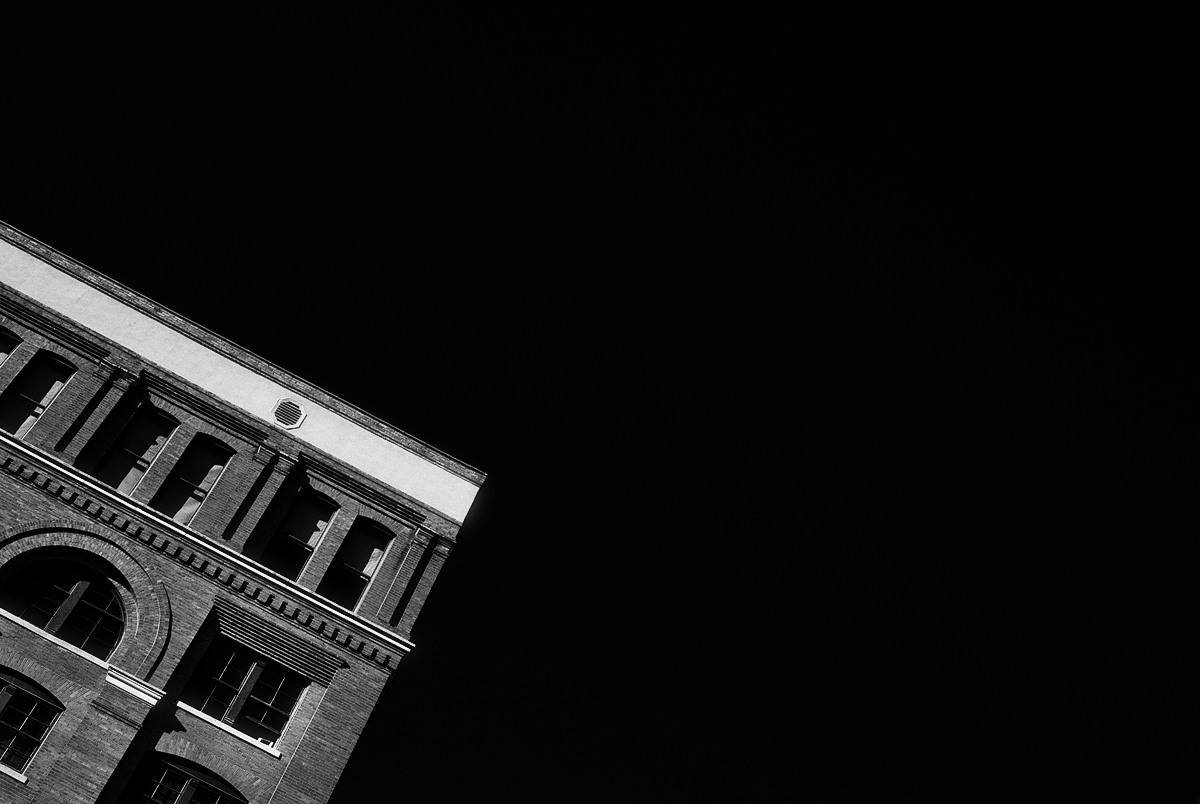
The sniper’s window on the sixth floor of the Texas School Book Depository

I have to admit to being a somewhat self-assured photographer. What I mean by that is that if I’m pleased with the images I make, I’m not particularly vulnerable to the negative criticism of others and that includes other photographers. Of course, I don’t always make myself happy. And what I’ve learned about failing to make images that I’m happy with is that it most often happens because I was unwilling or unable to do the hard work of seeing and capturing the great images that were there to be had.

I think good photography is challenging and difficult. I’m not sure it’s as hard as writing something interesting or playing jazz, the latter of which has been compared to changing the fan belts on your car while the motor is running.

I don’t think photography is quite that hard. But at 53 years old, the truth is it’s sometimes more of challenge to take great pictures than I am physically or mentally up to. And I probably wouldn’t be admitting that if not for the shots I’m going to present here.

I don’t consider this to be a strong set of images. They are far from it. I’m disappointed in them and, of course, myself. My excuses are that it was very cold in Dallas, I’ve lived in Los Angeles for the last 22 years and I’m not used to that kind of cold. And honestly, after watching the Pittsburgh Steelers lose the Super Bowl the evening before, up close and in person, I was tee’d off, burnt out, hung over, and completely over the entire Texas experience.

I’d taken my M9 to Dallas thinking I would come back with tons of great images. That was not to be the case. Photography is hard and as I said you have to want to take good pictures, and then you have to be willing to do the work to get those pictures. I wasn’t and I came back from the trip with very few images that I ever want to look at again.

Nevertheless, Dealey Plaza, the location in Dallas where President John Fitzgerald Kennedy was assassinated on November 22, 1963, is something else entirely. As a lifelong political animal who greatly admired both JFK and RFK, it was always my intention to someday get down there to see the site of this historic American tragedy.

What I found there, for the most part, wasn’t what I expected, but my overall impressions of the place, the aura that exists there, well…

Dealey Plaza is, almost by some kind of natural or unnatural energy, one of the most eerily amazing places I’ve ever visited in my life. More on that later.

But the strangeness of the experience of visiting there is compounded due to the ghastly and unacceptable way in which this historical site has been allowed to deteriorate, and also because of how it is presented to those who come to this historic place to try to absorb something of the terrible events that happened there.

L1013905-1200

Chipped paint and rust help mar the experience of visiting this historic site in Dallas.

The overall vibe of Dealey Plaza is electric, oppressive and somewhat disorienting. So much so that the first thing you may notice upon arriving there is exactly that; an atmosphere of mayhem and disorder that permeates the place. Remember the moment in Oliver Stone’s JFK when the pigeons bolt from the roof of the Texas School Book Depository? It feels like that moment.

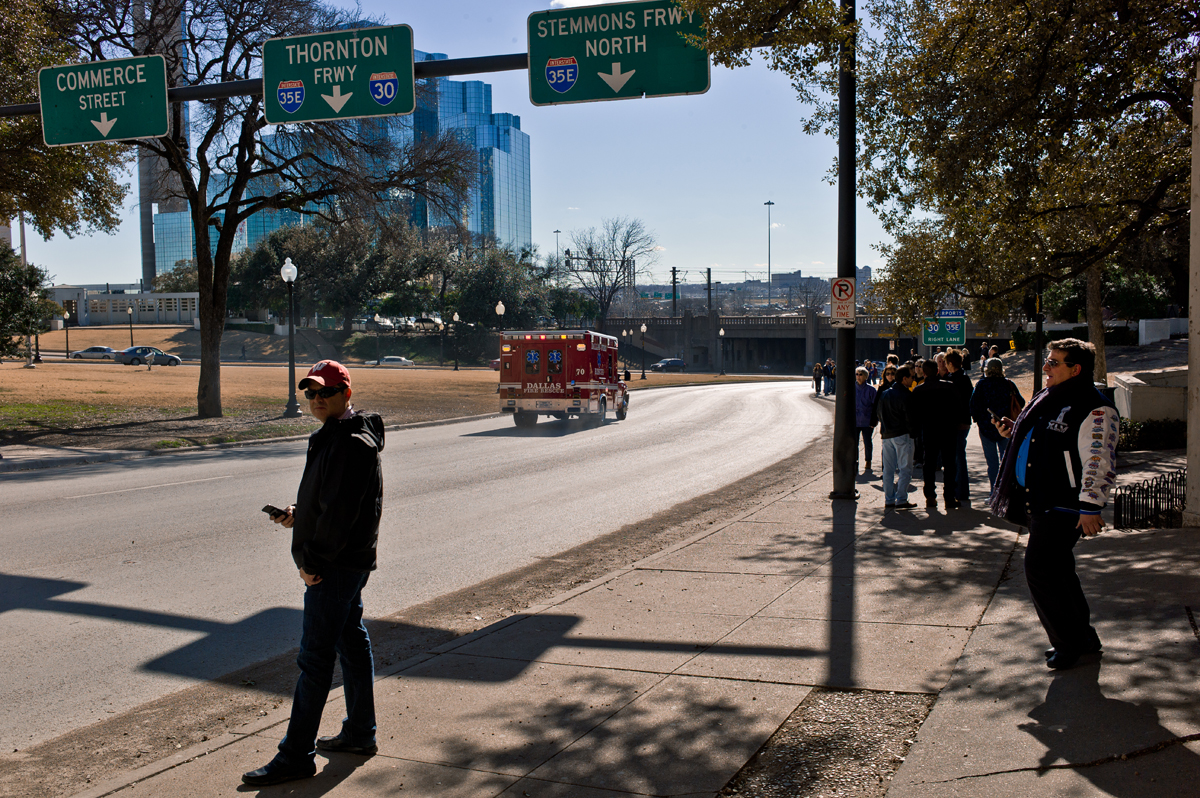
The entire area feels like a vortex of negative energy and soon after we arrived and were standing near where Abraham Zapruder shot his incredible film of the assassination, up at the bend from South Houston onto Elm, the last corner the president would turn in his life, there was the wild screech of brakes and a violent collision. Minutes later there was the sound of an ambulance. Someone had been injured, apparently seriously, as it wasn’t long before the ambulance frantically sped by us, right up Elm Street and over the spot where the president was shot.
L1013919-1

An ambulance rushes an accident victim injured at Dealey Plaza.

It’s a singularly bizarre place, there’s just no other way of saying it. And a serious traffic accident was just one of many things, the very real sights and sounds of Dealey Plaza in 2011, which contribute to setting the eerie atmosphere that exists there even today.

The lion’s share of that negative vibe in Dealey Plaza, however, isn’t generated by the weight of history or happenstance or traffic accidents. It comes from the fact that the place is in such a miserable state of disrepair that it amounts to a disgrace for the city of Dallas, the state of Texas, and the United States of America.

I live in Los Angeles. In what’s called the slums of Beverly Hills. But what I’m about to say goes for virtually everywhere in Los Angeles. There is more attention paid to the groundskeeping and upkeep and beautification of every apartment building on my street, every street in my neighborhood, and just about every building, house, park, intersection, center divider or median strip, car wash, parking lot, and public restroom on the West Side of LA than there is at the site of the assassination of the 35th president of the United States.

L1013884-1200

The infamous Grassy Knoll might better be thought of as the Muddy Knoll.

Paint is chipping badly. Rust stains are everywhere. The grass is trodden over, smashed down to dirt and mud under the feet of visitors. Graffiti covers key components of this historical site including the picket fence behind the Grassy Knoll where some say a second shooter may have fired shots at the president’s motorcade.

L1013882-1200

Graffiti covers the fence that some think obscured a second shooter.

But there’s one thing even worse than the disrepair at Dealey Plaza and it is an insult to history and everyone who visits the place as well as to the memory of the slain president and of the events that happened there.

The entire principle roadways, including the spot where Kennedy died on Elm Street, is still open to automobile traffic. The result of that is there is a dangerous and almost macabre scene played out minute by minute as visitors who have come to this spot to try to reconcile, understand, or simply just absorb the events of over 40 years ago are forced to dodge honking automobiles driven by alternately patient and speeding locals as they drive by on the three lanes of Elm Street.

Without a police officer in sight, it’s both a hazardous and out of control situation.

In Los Angeles, we close off busy sections of key streets in Santa Monica multiple times a week for a farmer’s market. They’ve permanently shut down five blocks of 3rd street in Santa Monica and turned it into an outdoor shopping promenade.

L1013926-1200

Visitors to Dealey Plaza brave traffic as they try to experience this historic site.

It is outrageous that the city of Dallas, the state of Texas, or the federal government of the United States, hasn’t as yet sealed off Dealey Plaza to car traffic and turned it into the historical mall that it should be. It is a TINY place in what is certainly a small section of the grand scheme of things in modern Dallas. Yes it would require permanent rerouting of traffic but nothing that doesn’t happen every day in every major city in America.

Texas, however, is a still yet a very strange place politically, and this situation is evidence of that fact.

So the bottom line is that, even though I’m very disappointed in my own photography from this trip, I’d hope that the images show some of the problems that I’m referring to. The graffiti. The people trying to stand on the spot where Kennedy died while traffic bears down on them. The general disrepair.

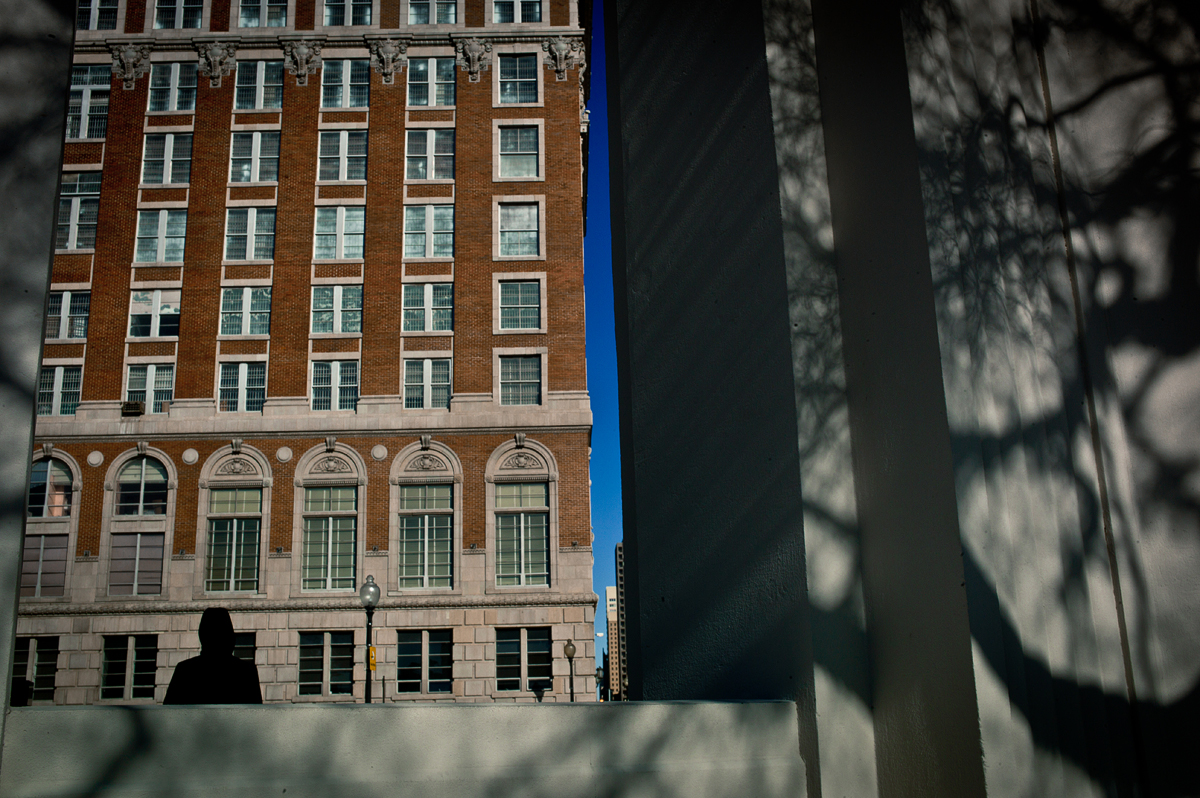
But I hope that my pictures also capture to some extent the weirdness and the aura of mayhem and negativity that hangs over the place. It’s a location where harsh shadows and mysterious figures are still juxtaposed with a fierce blue sky and glaring sun. Dealey Plaza and the Texas School Book Depository are haunted, maybe not by real spirits, but by real history. And it’s a cursed and, unfortunately, still dangerous intersection of clashing forces and cross purposes.
L1013969-1200

Dealey Plaza remains a place of fierce blue skies and mysterious shadows.

Five decades ago it was a young president whose motorcade happened to pass in front of the building where a raging loner named Lee Harvey Oswald worked.

Now it’s people trampling and marking up and slowly destroying a place of incredible historical significance to the United States while they themselves are threatened by the danger of distracted drivers trying to negotiate through their midst.

And on top of all that there is the unforgivable neglect of the site by the City of Dallas.

In Washington D.C they manage to balance the needs of a functioning government with the influx and presence of millions upon millions of visitors every year and it is carried off with dignity and safety. Dealey Plaza is not much bigger than the cafeteria at the Smithsonian. Its importance in terms of traffic and logistics to the city of Dallas is or very easily could be next to nothing. But its historical importance to our country and to the world is off the charts and it should be preserved and presented with the respect and dignity it deserves.