


We photographers deal in things that are continually vanishing, and when they have vanished, there is no contrivance on earth which can make them come back again. – Henri Cartier-Bresson


When it comes to suppressing free speech, the folks at the very top of Twitter, now rebranded as Elon Musk’s favorite letter, can’t seem to resist a good slogan. Perhaps inspired by the apparent success of the FOUR LEGS GOOD, TWO LEGS BAD chant from George Orwell’s Animal Farm, Elon and his somewhat new CEO Linda Yaccarino might have forgotten from their lofty perch how it all turned out for the poor animals who were suckered in by a catchy turn of phrase.
But we nonfiction animals haven’t forgotten.
Yaccarino sat for an interview on CNBC and, in just the span of the two-minute clip I saw, the new X-CEO managed to scare the hell out of me and I’m sure many others who still held out hope that the former Twitter platform was making slow, bumpy, but nevertheless forward progress towards removing all of the algorithms and ingrained political sentiments that continue to bedevil so many of us trying to get our voices heard.
That would be heard, as opposed to not heard. Just to be clear. Yes, we still have our voices. They haven’t taken those away from us yet. But very soon after taking possession of his newest toy, Elon would start tossing around the first of Twitter’s deplorable free-speech suppression catch phrases, Freedom of Speech, Not Reach.
What that means, and has meant for so many of us, is that you can speak as freely as you like on Twitter-X. But committed X staff and their algorithms will be watching and waiting and, following instructions coming down from people unseen and powers unknown, they can make sure that whatever you decide to post on Twitter can very easily and far too often be fixed so that it will be seen by you and only you, with the exception of the X minders themselves assigned with watching and censoring us too-free tweeting users.
I said what I said. Censoring. If there was a natural flow of information on Twitter as there had been over the first decade of its existence, our tweets or replies would be visible to our followers, to those looking for a topic by typing a hashtag into the search field, or to those just scrolling through a thread where our comments would be visible along with everyone else’s.
That is not, however, how Twitter has worked for most of the last decade. Politics inherent among those who worked at the social media giant, and quite probably many special favors asked of either employees or their higher ups, often resulted in accounts being downranked, shadow banned, and whatever other technical terms or internal methods might apply to censoring people’s voices at Twitter.
Then, in an effort I’m now assuming was all about garnering street cred among angry and disillusioned Twitter users who had long felt the wet blanket of the company’s former management impacting our accounts, Elon released tons of evidence that, not only was Twitter indeed smothering the free speech of many users, but it was also partnered with and answering the many requests by elements of the US government to silence user voices on Twitter engaging on a wide variety of subjects.
It would even become common knowledge that Twitter had actually put on the payroll many former employees of government agencies like the FBI. If we weren’t already seeing the pages of Orwell’s 1984 come to life before our very eyes as we read the Twitter Files, compiled by Matt Taibbi and Michael Shellenberger, the two investigative reporters made sure to remind us of the frightening similarities.
In her sit down on CNBC, Yaccarino showed that she could check every box on a psych eval for the most Orwellian Big Sister of our darkest nightmares. From saying exactly all the wrong things, to the authoritarian demeanor, speech inflections, mannerisms and body language, all very clearly signaling her presumed superiority, including some very trippy head-tilting befitting a lord of the star chamber grown weary of bothersome questions.
Yaccarino passed along to everyone watching, and I for one believe her, how committed X is “to encouraging healthy behavior online.” One aspect of X’s methodology in encouraging healthy behavior that Yaccarino was especially pleased with is how ‘staggeringly’ effective X employees are at both deciding what is unhealthy content and then, if not removing it entirely, hiding from view any such unhealthiness found on her platform. She smoothly glided past a question by the interviewer regarding who gets to decide what ‘healthy’ content is as if she herself had been created in an AI lab solely to assume the position she now inhabits lording over free speech on the most important socio-political discussion platform ever.
And then came the rhyming.
Touting the success of Freedom of Speech, Not Reach, a corporate free speech suppression gimmick that literally means that you can say what you want on X, but X is in no way obliged to actually publish you to anyone but yourself, Yaccarino added another rhyming humdinger from the twisted company brain trust that brought you FOSNR.
If it is lawful, but it is awful…
Beyond this being an insult to the memory of Johnny Cochran, does the rest of what she said even matter? You know what’s coming. Censorship. Some form of (they think) clever censorship that will surely befuddle the inferior masses.
Linda, the drill makes a sound and we know that sound. You can change the name of your platform to any letter of the alphabet you like, but as you haven’t as yet figured out how to cut off the electricity to our homes or shut off our internet access and you haven’t gotten (at least not yet) to where you can turn off our access to our own money (working on it) you’re limited to either throwing us off the platform entirely, which is completely unnecessary at this point, or making sure that no one else on X can see our contributions.
If someone posts a comment on X that is, as Yaccarino puts it, lawful but awful, she openly admits that the busy bees at X will make it “extraordinarily difficult” for anyone else on the platform to see it. And the way she lays into extraordinarily you know she means it.
Who exactly, or what, is handling the incredible workload of deciding what users will be platformed on X and what content they’ve posted is either healthy or awful? Yep. Meet the new boss. Same as the old boss. Twitter employees and algorithms.
“We have an extraordinary team of people who are overseeing, hands on keyboard, monitoring, all day, every day, to make sure that that 99.99 percent of impressions remain at that number.”
Oh, did I forget to tell you about the 99. whatever percent of impressions thing?
That’s the number of all posted impressions that Yaccarino can confidently sit before us today and say are healthy.
Hmm. Somehow she says healthy and I hear pure. I must have been infected with some less-than-optimal thoughts after reading a book or two. What then exactly is being hidden on X? Yep. You must have read the same books I did. Impure thoughts. You can have them. You can even post them on X. But we will, to staggering degrees of success, hide them from the world.
And, by the way, we’re shooting for the old Ivory Soap standard. Nothing less than 99.99 percent pure will do.
If only this were Orwellian fiction. If only so many of us were not suckered into believing that Elon Musk’s purchase of Twitter would result in the platforming of free speech at a moment in both American and world history that has never more desperately needed a communications platform that would allow absolutely unfettered freedom for citizens the world over to voice our disagreements with those who govern this planet; our dissidence, our outrage, our questioning of authority, our disagreements with each other, and then to formulate and express together, as truly free citizens exercising our once unassailable right of free speech, our own thoughts, objections, suspicions, our own demands for change, and our own solutions and hopes for better tomorrows.
Say goodbye to all that.
I would love to suggest that these people don’t even know what free speech means. Oh that we were that lucky. They could then be educated. They could be turned. But that’s not what’s happening. They are corporate animals. And I am sure that every single person reading this has had some experience with corporations. The team at X has crafted a narrative that absolves them from doing exactly what they are doing. In this case, it is suppressing free speech. In any case, it is what corporations do.
But why are they doing it after Elon Musk promised to do the polar opposite with Twitter? I can say something about the inevitability of this giant billionaire-owned business eventually reverting back to behaving like a giant billionaire-owned business. I could say, as many long have, that Elon never intended to allow free speech and was only messing with us. I think there’s plenty of truth in just these two explanations coming off the top of my head. But I can’t know the specifics.
The early adoption of a freedom of speech suppressing catch phrase long before Yaccarino took the helm of Twitter was a solid hint that more of the same would be coming. Her selection as CEO set off alarm bells for many familiar with her background.
I will say that I believe with the utmost certainty that the two now most prominent figures at X know full well that they’re actively plotting and engaging in the suppression of free speech on their platform and that they are further tweaking and designing a social media X-Twitter-scape that will continue to obscure both their true intentions as well as hiding away from public view what they and the rest of the establishment classes would doubtless agree are the unhealthy thoughts and opinions of much too many of us.
I believe that Elon Musk and Linda Yaccarino fully understand what free speech is and exactly what they’re doing to it on their platform. They certainly understand what free speech means to them and their platform.
But they certainly don’t understand what free speech means to me. I promise you; they have no fucking idea. And they have no idea what free speech means to this country. Still means. Will always mean. If they did then no matter what these two have done in their lives so far or ever hoped to do going forward, they wouldn’t be doing this. They wouldn’t be doing to free speech in America what they’re doing to it right now.
Yesterday, watching Yaccarino’s first public performance as X-CEO was a dark day for me. I believe it will come to be seen as a dark day for free speech everywhere. But I have to say this, I think it was an especially dark day for the platform formerly known as Twitter.
So this is my message for the platform now known as X; its owner, its corporate leadership, and everyone who works there.
People the world over have been through so much. We’ve just come through a once in a century pandemic that killed possibly tens of millions. And throughout that pandemic we were locked down in our own homes, our businesses and schools shut down, all involuntarily. We were mandated to take vaccines that were poorly tested or lose our jobs.
And yet we weren’t permitted to speak amongst ourselves about so much of this on the social media platforms that have become our connections with each other, yours included.
We were lied to about the most likely origins of the virus. And we weren’t allowed to talk about that either.
We then found out, by way of YOU, Elon, that our government, federal law enforcement and homeland security, along with elements of the Democratic Party and party friendly NGOs were all working to silence the voices of Americans on Twitter. We learned, for instance, how the effort to crush the Hunter Biden laptop story prior to the 2020 election was the result of coordination between these political and governmental entities and social media platforms.
And this is just a fraction of how the ability of Americans to openly discuss and debate issues pertaining to their very lives was suppressed by Twitter’s own efforts. There is so much more that has been done to us on this platform and others.
Yes, people have been through a lot these last five years. We will be in the process of recovering from it all for a very long time. But couldn’t you give us back those five years? Elon? Linda? I’m speaking directly to you both. Couldn’t you just allow people on your platform to speak freely for five years, without your staggeringly effective suppression of our most basic freedom as Americans?
Couldn’t you give back to the people of a nation that has depended so much on free speech throughout its history the years of that precious freedom the platform you now control took from us?
So, I’ve decided to write this piece to expose, I hope to a great extent, a serious issue I’m having with this now essential, possibly democracy saving, new form of political journalism that I myself love and depend on to provide my heart and mind with the hope that at least someone with a bigger platform than my own is seeing what’s happening in the world as I see it.
And that hope was truly reinvigorated over the last five years upon discovering that so many bright well-educated young people are of much the same mind regarding our current cultural and political challenges as this old dude.
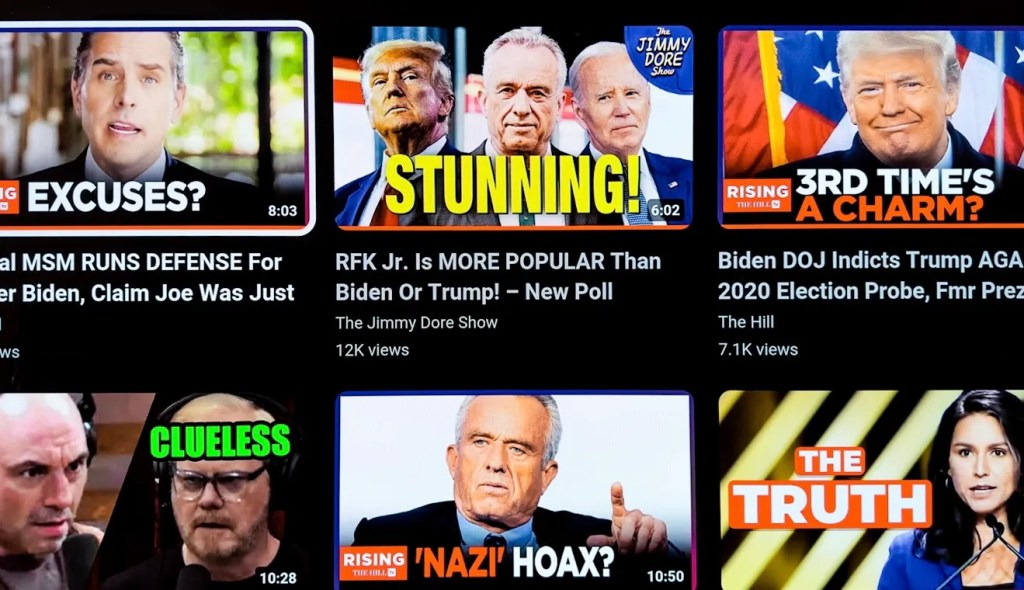
I’m referring, of course, to those now suddenly never-more important outside-the-mainstream independent media voices that initially coalesced around podcasting, moved on to the slick studio-based news and political analysis programing we see daily on YouTube and other streaming platforms, as well as the many who have found a home here on Substack.
One thing that has been a constant and oh-so-true refrain on indie media for the entirety of its existence is that the mainstream establishment press isn’t reporting on so many stories that have great importance to the public. Who could put a number on how many times we’ve heard that complaint coming from the hosts of Rising or Breaking Points or from Joe Rogan, Glenn Greenwald, or Russell Brand?
And that’s essentially why we watch and listen to these voices and why they even exist in the first place. It’s why they are necessary. They’re filling a void. The very existence of that void represents an egregious failure. It shouldn’t be there. The mainstream news media should be telling the stories we see every day on the independents. But, almost invariably, it is only on indie media that such stories are brought before the public.
I’m just going to leave that thought out there with the hope that it will continue to resonate for the remainder of this piece.
One such story, likely the most important story any journalist alive at this historic moment will ever cover, is the almost exclusively journalistic pursuit of the truth about the origins of the COVID-19 pandemic.
I say almost because there are efforts being made in the United States Senate by the Republican minority. But heretofore it’s really been only independent journalists, along with a smattering of scientific researchers, doggedly working their way through documentary evidence, that has brought us closer than we’ve ever been to knowing how a novel coronavirus first infected humans in Wuhan, China, a truly cataclysmic event that led to millions of lives being lost around the world.
Out in that very real world, millions died from the virus, leaving behind tens of millions more permanently traumatized by what happened to their families over the last four years. But it is my observation, potentially flawed as it may be, that we’re not hearing from those people. Their tragic first-hand coronavirus stories are not, as far as I can tell, being widely shared with the public.
So it is my most sincere hope for this particular piece that I’m able to impress upon the devoted journalists and scientists pursuing the lab leak story, and anyone else for that matter, that they should look at the continuing public conversation about the lab leak and really all things relating to the pandemic and notice that there is one thing glaringly absent from the conversation: That would be the voices of those who have actually lost family to the coronavirus, their stories, their tragic details, giving first-hand accounts of the trauma visited upon them and their loved ones by this most awful, and most likely man-made, human catastrophe.
Almost two weeks ago I posted a piece here on Substack telling of one such family’s experience with COVID. It was the story of my own wife’s family; her brothers and sisters as well as one nephew.
But the piece I published, ‘Let the Inquisition Begin’ isn’t just a story of COVID hitting some people, it’s a story of COVID hitting certain people, a certain type and class of Americans who aren’t really on the radar of either the prestige legacy media or even the indie voices who appear to share with their mainstream counterparts an economic and educational background that stands very far apart from the kind of people who typically live in the regions of the country where my wife, her family, and I all come from.
My piece is the story of what happened when a lab-engineered supervirus hit one Western Pennsylvania family. And, as such, it’s also very much a story about COVID hitting a family in the context of that family’s socio-economic positioning in America and, also, to their tragic detriment, their place on the world stage of events.
How our family reacted to everyone suddenly coming down with COVID maybe speaks to how so many Americans reacted to coming down with COVID and why there was a disproportionate amount of more severe cases and deaths the further down in class victims of the virus happened to be.
But my piece is also a story of the many working-class eccentricities of Americans living outside the coastal enclaves of the highly educated and generationally affluent and how those eccentricities played into the outcomes that were more likely to be experienced by such Americans.
Interesting stuff, no? They used to call these human-interest stories. I’m not sure if they still do. They’ve been an essential part of the journalistic tradition forever. They bring often tragic personal stories home to readers in such ways that people can more easily relate to. They have an emotional impact that mere factual reporting most often doesn’t.
These are all things that are contained in my piece. Some of it is overtly addressed and some of it is written between the lines. And some is probably just baked into my writing without me even knowing it due to my voice being that of a person who comes from that very same background. These are the things that make my piece important and, as incredible as this seems to me with upwards of 10 million dead worldwide, more than just a little bit rare at this moment.
But these are the kinds of things I would be talking about, if anyone in the media was actually talking to me about my piece.
Today, whenever someone is unjustly killed, murdered in a criminal act, or by an act of negligence, or by accidents that just shouldn’t have happened, even just one single human being, we might hear about that death on the news for years. Then that single solitary death might be deemed a historically important event and be recorded as such and thus live forever as a political touchstone.
The lead story on one of the 10 PM news broadcasts here in LA the week prior to me publishing my piece was of demonstrations calling for justice in the absolutely unacceptable police shooting of a Trader Joe’s worker that happened after a gunman entered the store in which she was working. It was a terrible and unnecessary taking of a much-loved young woman’s life. But it happened five years ago. Just one death. And yet here it was opening the 10 PM news broadcast in Los Angeles five years later.
And that’s fine. It really is. But the thing is, in contrast, we’re not hearing at all from families who suffered the worst outcomes of a pandemic that very well might have killed upwards of 10 million people worldwide. Are we? My sincere answer to that question is that we are not, but if I’m wrong about that please, someone, show me those stories.
There’s no question that a major factor in the dearth of stories coming from families who suffered the worst outcomes during the pandemic is that the general public, by and large, especially the part of the public that isn’t watching independent media on YouTube or reading Substack newsletters, is unaware of how convincing the evidence has become that the virus was the result of both gain of function research and an accidental lab leak.
And even though a recent poll shows that two thirds of the American public believe a lab leak to be the most likely cause of the coronavirus pandemic, we’re still a long way from anything that looks like a firm confirmation of that likelihood being delivered to and processed for what it is by the citizens of this country and the rest of the world.
So if a significant percentage of Americans are still ambivalent about the origin of the virus, if there’s no breaking news confirmation of the lab leak theory on their broadcast network television screens, something that appears unlikely under any foreseeable circumstances, and they’re looking at the pandemic as a terrible, once in a century act of nature, then I will admit there’s not going to be much of a market for stories of people’s families getting sick with what the mainstream media has consistently and quite rigidly maintained was a completely naturally occurring virus.
It’s only the looming possibility of COVID-19 having come from dangerous scientific research and a disastrous accidental lab leak that supercharges the millions of tragic individual stories that can be told from around the world of the destruction of lives that occurred as a result of government funded scientific research gone horribly wrong.
Thus the piece on my wife’s family’s devastating encounter with the coronavirus has turned into almost an unintentional scientific experiment of its own. Where does this story go? How far? Does it just die on my Substack page with pretty much no one having read it? It seems at this point that that’s where things are going. Or will my wife’s family’s story be carried to a wider audience?
Are any of the conversations happening around these matters even now being carried to wider audiences? I’m referring to the daily coverage and analysis on indie media of the many COVID controversies over vaccines, lockdowns, and, of course, the highly polarizing journalistic pursuit of the true origins of the virus.
It seems to me that all of these subjects and the discussions surrounding them are, at this point, occurring only between a few thousand people, if that, largely on social or new media platforms that the vast majority of the human race doesn’t interact with.
How do we get these stories in front of a wider audience? What happens if we are unable to? At what point do even people with powerful voices and important stories to tell simply give up?
I find myself grappling with those questions a lot lately. If virtually no one is reading my pieces, if they’re not even being shared by the like-minded, how much longer will I continue to do this?
At this point it would seem to me that everyone is part of the control mechanisms of who gets heard in society. Not just the government or social media platforms overtly trying to limit and control free speech. It’s even fellow travelers. It’s even those working in the areas of uncovering the truths about the pandemic and those directly fighting the government and corporate efforts to censor the voices of the American people.
Everyone is now a part of the determining of whose voices are heard in society. This is now an unavoidable modern-day reality that’s part of the inherent feature set of the mostly social media platforms we’re all using to interact with each other.
As of this writing, it looks like 144 people have read my Inquisition piece here on Substack.
Some of the more important voices on this platform have hundreds of thousands of subscribers and collectively millions of followers on Twitter. Just one retweet from any of the indie media accounts I tagged when I first published my piece almost two weeks ago and thousands would have already read the story of what happened to my wife’s family.
Everything that the independent media is doing on the subject of the COVID-19 lab leak story and most every other subject they cover is about telling people what happened. That’s what they do. And I’m sure, that by telling people what happened, they’re hoping that people will then demand better from those in power.
What the independent media is all about is getting a response from the public. Is it not?
I’m certainly no different. I’m not writing pieces on Substack for my own enjoyment. I’m writing them because I want them to be read, I want my voice to be heard, and I want to have an impact on the issues that I believe matter most to the American public. I’m that old dude.
And from what I can see, I’m no different, in that respect, than those who make up the independent media. I think we’re all trying to accomplish the same things.
The quality of work and analysis coming from this relatively tiny group of individuals who make up the independent left media is I believe unmatched in my lifetime. In comparison, I’m just a grumpy voice coming from the back row where I belong. But all of our voices are badly needed right now, maybe like never before in the history of this country.
I don’t worry about the sincerity and commitment of the independent media voices I follow and support. It does however seem to me to be a bit of a clubby closed group with a lot of people competing for the attention of a limited segment of the public and any rewards that might bring.
I would strongly suggest to those who make up the independent media that they should more readily embrace voices coming from the general public who make the kinds of serious efforts I’ve made as well as so many others.
They must be seeking an impassioned response from the public as they produce their badly needed journalistic work. Things only change when there is such a response from the public. My pieces here on Substack are a part of that response.
Please help make sure that our voices from the back row are being heard, too.
The first we heard of sickness back home was mid-November 2021. My wife’s youngest brother, Anthony, an associate English professor at Robert Morris University, was having GI issues. Persistent diarrhea to be exact. Then the entire family still living in our hometown of Aliquippa, Pennsylvania had what seemed to be bad colds, then fevers.
Bernadette is one of eight siblings: four brothers and four sisters. We’re in Los Angeles. Another sister is in Florida. The other six, along with her youngest sister’s husband and 26-year-old son, lived in three households in the Pittsburgh area. That makes eight close family members in all living in western PA.
Like a pair of California cliches, we got on Amazon and ordered for Anthony a Chinese herb we’ve taken in the past for digestive problems. He’d been the one relaying information to us here in LA and it wasn’t long before updates on the three brothers living together under one roof in the Plan 12 section of Aliquippa became less frequent but increasingly worrisome. My wife came back to LA in late March 2022 after her first trip home to Pittsburgh since COVID struck her family. She brought back the Chinese herb we’d ordered on Amazon four months earlier. It was unopened.
Throughout the pandemic, most Americans were confused about what exactly to do should they fall ill with COVID. From the first large wave of outbreaks in the US in the late spring of 2020, when hospitals were at or near their capacities due to emergency rooms being flooded with people sick from the novel coronavirus, the official stance centered largely on folks contacting their personal physicians. It seemed from there the advice of doctors was mostly to isolate at home and to not go to a hospital until the onset of significant difficulty breathing.
Of course, many Americans don’t have a family doctor. This inconvenient wrinkle in the American healthcare system would only compound the potential missteps for so many who happened to be suffering a sudden and potentially deadly illness. This certainly played a role in what happened to my wife’s family. So for them, and I’m sure so many others, the confusion about what to do should someone fall ill with COVID, something that persists to this day I would suggest, combined with the realities of the tenuous relationships so many Americans have with their own nation’s health care systems, all but guaranteed countless unnecessarily bad outcomes.
The part of Pennsylvania where we come from, sitting near the foothills of the Appalachian Mountains, is in the heart of what was once America’s rust belt. Despite being just west of Pittsburgh, with its great universities and thriving downtown, Aliquippa and the surrounding communities, like most of the areas outside of the city, have never really recovered from the decline of the American steel industry.
So take that national confusion about what to do in the event that you or someone you know should come down with COVID and drop it deep into what’s left of a tough industrial working-class mindset. People are stubborn and apprehensive of even generating an ambulance bill, let alone what might come later in the mail from a trip to the ER. Mistakes will be made. None of the five living in our hometown had a primary care physician and there was a real resistance to dialing 911 in all three households.
When we were able to get through to Anthony, he was often barely able to speak. One evening he told us his next oldest brother, John, was lying half off his bed, semi-conscious. Anthony himself was too weak to check on his oldest brother, “Winnie,” a tough 73-year-old Vietnam vet who was now bedridden in another part of the house.
Across town from Anthony and his two older brothers, in the DiMattia section of Aliquippa, Mickey, the oldest sister at 70, was sick but able to move around her house and answer the phone. But her younger brother, Jay, 67, who’d moved in with her about a dozen years earlier, hadn’t been out of bed in more than a week.
Anthony and John are 58 and 60 years old respectively. They are referred to in the family as “the boys.” I’m 65 and I’ve known them since they were 10 and 12 years old. By now everyone fully suspects that this is COVID. Text messages from Anthony told us that things were only getting worse where he was in Plan 12 with his two older brothers. So the day after Thanksgiving we called my wife’s youngest sister, Basie, who lives about 25 miles away on the outskirts of Pittsburgh and told her that the two youngest boys needed to go to the hospital.
This led to a moment when the unforgiving biological realities of the coronavirus would collide with the uncertainty and suspicions of strong-willed people who had been, up to that very moment, able to live most of their long lives virtually outside of the American healthcare system.
Basie and her husband Keith were going to make the half-hour drive down to Aliquippa. So the conversation from here in LA went something like this:
Don’t go into the house. Call 911 and watch the EMTs put the boys in the ambulances and then go home. The hospital will admit them. Whatever you do, don’t go into that house and don’t drive the boys to the hospital yourselves. Call 911.
And this is how we left it. The boys would be getting proper medical care, and that’s all we needed to happen at that time.
But Basie was sure she’d already had COVID back in the spring of 2020. She’d had some minor symptoms consistent with COVID and had lost her sense of smell and taste for weeks. She felt that she had immunity to the virus. Keith also thought that he’d been exposed to COVID at work and could count on having some immunity. And there was that hesitancy to call 911 and incur likely hefty ambulance bills. So the pair did go into the house in Plan 12 and proceeded to drive Anthony and John themselves to the ER at UPMC-Heritage in Beaver, Pa.
This was Friday evening, November 26.
It’s stunning for us to think about it now, but until this very moment in November of 2021, with the US death toll slowly nearing 800K, neither of us here in California had known a single person who’d had COVID. And after what had been a merciful respite from the many waves of coronavirus here in LA throughout the summer, we felt safe enough in November, with about 60K other people, to go to a Sunday Night Steelers-Chargers football game at SoFi Stadium.
There’s not a personal story about someone’s tragic experience with COVID that’s likely to hold the average American’s attention for long at this point. We’re all just so over this horrific era in human history. And yet the politicization of the pandemic, on all of its many fronts, from masking and lockdowns to the wars over vaccine mandates and harmful side effects of the jab, seems to grow more passionately divisive every day and will likely be with us long after the last COVID variant disappears over the horizon.
In the ER the boys sat waiting for hours before being taken back to an examination room where they tested positive for COVID. They were told that their vital signs were good and that it was too many days into their infection for them to receive colloidal antibody treatment. They were given Tylenol and sent home. During the long wait at the ER, Keith had taken Basie home. He then drove the boys back to their house in Aliquippa.
When we learned that the boys had been sent home from the hospital we were devastated. The family was well into their second week of what we now knew to be COVID and were only getting sicker. By that time, in late 2021, we thought Delta was the most likely variant the family was suffering with and so we knew the danger they were in. These were days of agony for my wife.
A week after the boys were sent home from the ER, Bernadette walked into our apartment from work with her cell phone to her ear. She was talking with Mickey, her oldest sister. The pitch of Bernadette’s voice froze me in my seat and on the other end Mickey was speaking so loudly I could hear every word she was saying from across the room. Jay’s car hadn’t been started in weeks and he’d gotten out of bed, dressed, and gone outside to move it from the street into the driveway. But that was 45 minutes ago and now, Mickey said, he was just sitting there, behind the wheel.
I’d experienced something like this before in my life. What I always remember about that time is that it didn’t really seem like what it was. And if it wasn’t for what I knew was happening back in Pennsylvania at this moment, and the stress in my wife’s voice when she came through the front door, I honestly wouldn’t have been paying much attention to what was being said between these two sisters.
“Tell her to go outside and check on him.” I remember how my words startled my wife. It was as if me simply telling her to tell Mickey to go out and do this most obvious thing had pushed a button that instantly brought Bernadette’s worst fears to the surface. The reality was a most devastating realization of those fears.
Jay had passed away sitting in the driver’s seat of his car. You never forget these moments in your life. The details of a family tragedy will always burn themselves into your memory. For me it was my wife shouting into the phone over and over again, “He’s dead?” clearly begging for it not to be true. And then her wailing.
This was a family of eight siblings who’d reached, on average, their mid-sixties without ever having lost anyone. Jay’s death was simply unbelievable to all of us.
Jay had possessed such a brilliant mind that when we were young I remember always being intimidated in his presence. I will never, in all my life, read as many books as Jay consumed in any one single year of his. He was incredibly soft-spoken but he was the kind of person you stepped up to with your own intelligence. What I remember most about every conversation I ever had with him was the questions which so often stumped me but also what an intense and respectful listener he was. I so wish now that I’d spent more of the last 37 years I’ve been in LA back home talking with him and learning from him.
But we could hardly focus on grieving for Jay. We couldn’t simply do what families do when a loved one passes and try to process our loss. This was COVID-19 and our eyes were wide open. Jay was 67 years old but he was in solid physical condition. He took vitamins by the handful. He walked every day, was a frequent hiker and, for most of his life, a weightlifter. Other than Anthony, he was certainly the next most physically fit member of the family. He had no comorbidities and no health issues at all that the family was aware of and yet COVID had killed him in a little over two weeks. Across town, Anthony, John, and Winnie were likewise three weeks into a virus that so often only begins to do its worst to the human body as infections move beyond the second week. Bernadette was now terrified that she would lose even more family to the virus.
My wife, her sisters, Keith, and I discussed whether we should tell the boys that Jay had passed. We all agreed that it wasn’t the right time, as we believed that the three were themselves still very much in a fight for their lives. So when Bernadette talked with Anthony the next day and he asked how Jay was doing, she told him that Jay was in the hospital. His response will stay with her always, “That’s where I should be.”
The next day, Basie and Keith had just left the boys in Aliquippa and called us on their way home. We were told it was a beautiful Saturday in Pittsburgh. I remember my wife and I were driving somewhere in Santa Monica to get dinner and we four were on speaker phone in the car. As far as they could tell the three brothers’ conditions hadn’t worsened and we all took that as good news. I think after such a terrible loss we needed one moment and just one phone conversation that could be characterized as hopeful. But at the end of our conversation Basie added that she had a scratchy throat and felt like she was catching a cold.
So, if you’re wondering, by now, as everyone reading this must surely be, was anyone in this family vaccinated? The answer is no. No one was vaccinated. There was a very strong anti-vaccine sentiment among the girls in the family that, believe it or not, persists to this day. The boys, however, were far less political and had seemed more or less ambivalent about getting vaccinated against COVID. But, ultimately, none of the four brothers were vaccinated.
Three Ambulances, Three Hospitals
The next day Keith drove down to Aliquippa alone to check on the boys as Basie had gotten sicker overnight. Moments after stepping into the house in Plan 12 and without even looking in on the other two brothers, Keith was on the phone with 911. Anthony, a marvelously fit bicyclist and hiker, and a notoriously healthy eater, was unresponsive, apparently conscious but staring blankly and unable to move or speak. Keith immediately suspected that he’d had a stroke.
Each of the three brothers were taken to different hospitals. Winnie, the Vietnam vet, was taken to the VA hospital in Pittsburgh. He would be there for almost a month as he was treated for a blood clot on his lung. John, who’d been so weak that he was unable to speak on the phone since the entire ordeal began, was taken to UPMC Sewickley Valley Hospital with COVID pneumonia where he would stay for three weeks before being transferred to an extended care facility for an extra month to recover his strength.
Anthony was life-flighted to Presbyterian, the stellar University of Pittsburgh adjacent medical center in the Oakland section of the city. The main threat to his survival those first weeks he was at Presby was still very much COVID-19. His oxygen levels were so low that the next step would have been putting him on a ventilator. My wife and I here in California were now the family contacts making medical decisions for Anthony. There was a conversation with one of the incredibly kind doctors taking care of him. I remember he used the word devastating to describe the stroke Anthony had suffered. He said it three times.
The takeaway from the discussion was that given the severity of Anthony’s stroke and the difficulties he would have simply recovering from that level of brain injury, putting him on a ventilator for an indeterminable period of time was something that neither the family nor the doctor felt would have been the best decision for Anthony.
Fortunately, it never came to that. Slowly, the grip that COVID-19 had on Anthony’s respiratory system eased. Within a month, he would be transferred to UPMC Montefiore which specializes in rehabilitation. But Anthony’s condition was not suitable for the level of rehabilitation therapies offered there so we were immediately tasked with finding a skilled nursing facility that had room for him and, it was hoped, one with a good track record for rehabilitating stroke victims.
Deciding on where Anthony should go led to one of those cards-on-the-table moments that no family ever wants to face. My wife and I were out walking on Canon Drive on a bright January morning. Her cell phone rings. It’s a patient relations rep at Montefiore following up on what extended care facilities in the Pittsburgh area might work best for Anthony. We step into the doorway of a closed shop and put her on speaker phone. But in order to give informed input on where we would like Anthony to be sent, we now have to have, finally, that no-illusions discussion establishing exactly what his condition is, what it really means, and what his prospects are.
There’s not much talk about sending Anthony somewhere where he’s going to get specialized physical rehab, he’s far from being a candidate for that. He’s paralyzed, of course, on his right side but they have to keep him restrained because he’s not mentally aware enough to avoid interfering with the IV and feeding tube with the mobility he still has on his left side. These graphic realities of her youngest brother’s condition move across my wife’s face like a shadow. She would tell me later that until that moment, she’d had hope. She’d really thought Anthony was going to get better.
While all of this was happening, back in Oakdale, just outside of Pittsburgh, Basie had continued to worsen. At one point her son would find her unresponsive in the bathroom. When the ambulance took her away, her husband was too sick himself to accompany his wife to the hospital. Basie would spend the better part of three weeks in the hospital but would ultimately pull through without any long-term complications. Keith would quickly recover from his COVID infection.
Their slim 26-year-old son, however, would also come down with the virus, and he would develop a blood clot, something that by all accounts was very rare in younger COVID patients. But thankfully, he too would recover within a few weeks.
Jay’s official cause of death was recorded as a pulmonary embolism, a blood clot in the lung, that came as he and his three brothers were into their third week of being bedridden with COVID. But COVID isn’t mentioned on his death certificate. Anthony’s stroke was caused by a blood clot in the brain. Winnie had a blood clot in his lung. Basie’s biological son developed a blood clot. All within one month’s time. None of these people had been vaccinated. All had COVID. None had received any COVID treatments before presenting with blood clots or the devastating effects of blood clots. None of them were ever placed on a ventilator.
We know that what happened to my wife’s family was unusual. Eight sick with COVID. Six of those eight, very ill. Total time spent in hospital by the family was close to four months. Four blood clots. One devastating stroke that ruined a 58-year-old’s life forever. And one tragic death. Yes, this was unusual. But it wasn’t unheard of during COVID. And it wasn’t anywhere close to being the worst outcome suffered by an American family during the pandemic.
A Call For Justice
Throughout the COVID-19 pandemic, we were told repeatedly to trust the science. And more than anyone on the face of the earth, the person most representative of the science that Americans were being told to trust was Dr. Anthony Fauci. But now we see that Dr. Fauci may have knowingly circumvented the 2014 directive of former President Barack Obama to pause any further gain of function research on harmful viruses within the American scientific research community.
We have also recently learned that Dr. Fauci may have influenced the creation of a paper entitled The Proximal Origins of SARS-CoV-2 that sought to divert attention away from the idea that the novel coronavirus had been engineered by research scientists in the Wuhan Institute of Virology working off a grant that had come from Fauci’s own National Institute of Health.
If this is true it likely led to a scenario never before seen in human history: A pandemic, actively killing millions around the world, caused by a virus that was created in a laboratory through research that was both outlawed by the government of the United States, while at the same time it was being sanctioned and funded by decision makers at the highest levels of that very same government’s public health apparatus. And the highest-ranking health official of all, someone we now know to have been administratively connected to the risky research itself as well as the deadly lab-leaked pathogen it created, was the most prominently displayed figure on our television screens as the representative of the science that we were being told to trust.
People have called for something akin to the Nuremberg trials to pursue justice in the aftermath of the COVID-19 pandemic. Certainly, some form of international world court would be justified and appropriate in the wake of the global death and societal destruction caused by what appears now to have been scientific research gone terribly wrong. Families and victims of what happened over the last four years should be far more than simply present at any such proceedings as mere voices on the sidelines. People who have lost loved ones must have the most prominent of voices in any official proceeding that seeks justice for this most disastrous course of human events in any of our lifetimes.
The court must be unimpeachable in the eyes of the public the world over and the punishments it hands down must be commensurate with the unprecedented loss of life that resulted from both the failures of scientific negligence as well as the intentional bureaucratic acts that paved the way for this human catastrophe. Justice must be served for the tens of millions whose lives were taken if we are to ever trust science again.
Likewise, anyone who participated in a cover up of evidence pointing to a scientifically engineered super-virus and the potential of that virus escaping from the Wuhan Institute of Virology must also face the most severe of punishments.
Just think of what could have been done had we known precisely where and how the virus originated back in the early days of the pandemic. We could have had the most pinpoint focused contact tracing possible enabling us to quarantine only those who had actually been in direct contact with the virus instead of locking down the entire human race for nearly two years. And it is entirely possible that we could have isolated SARS-CoV-2 in one region of the world and avoided completely the deadliest global pandemic in over 100 years.
Aftermath
My wife has lived in LA for 35 years and almost every one of those years, with the exception of 2020, she’s flown home at least three times a year to be with her brothers and sisters. Her love for her family is so strong that it would surely be seen as irrational by those who suggest severing ties with family members who refused to be vaccinated.
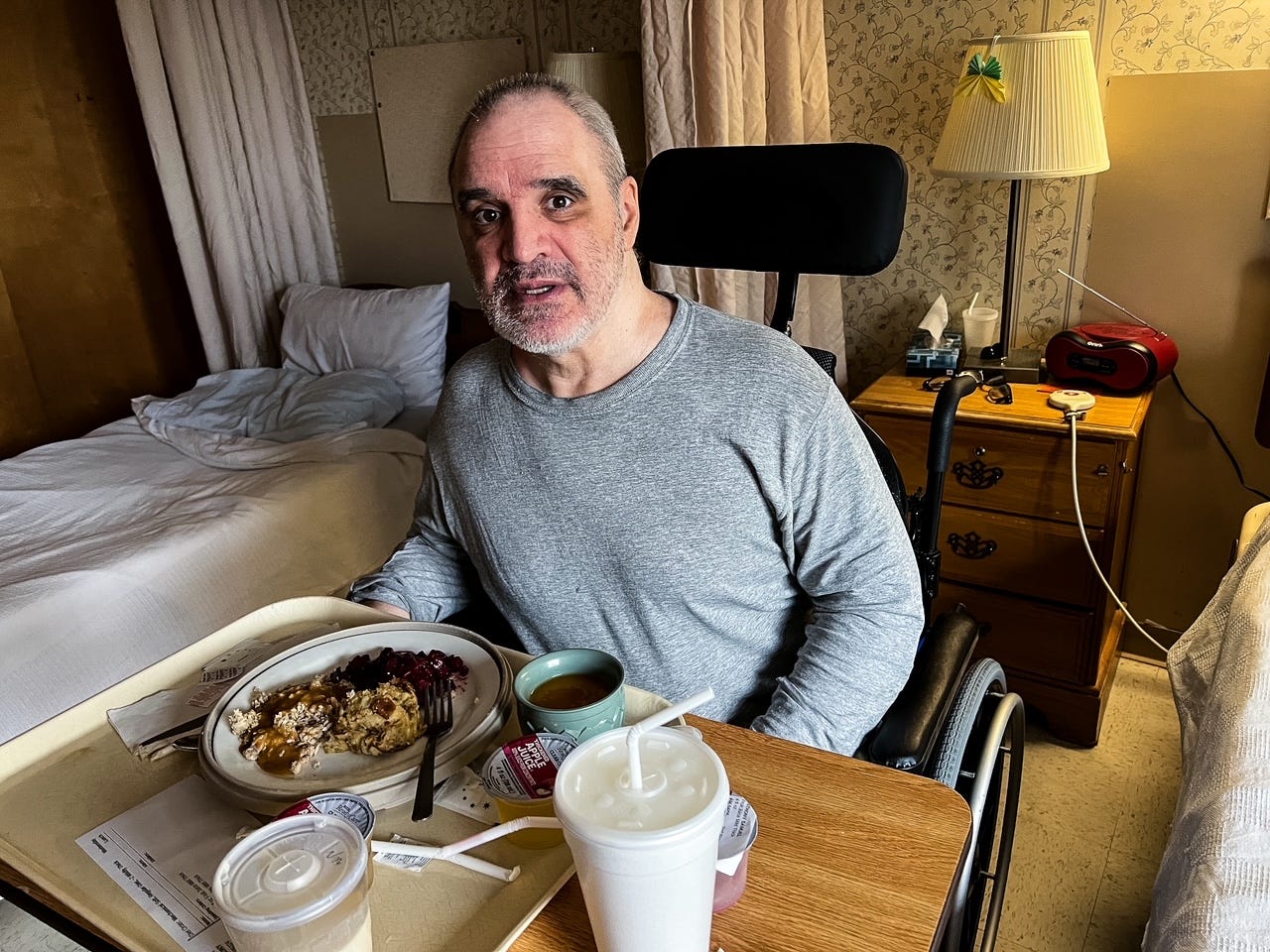
In the 16 months since her first trip back after COVID struck her family she’s gone home to Pittsburgh ten times. She spends most of her time there now with her brother Anthony in the skilled nursing facility where he has been for the last year and a half. Bernadette always believed that Anthony would get better, and at the end of the day nothing she could have been told by those attending to her brother would have changed her mind.
Anthony was a physical specimen throughout his pre-COVID life. He was naturally muscular even as a teenager and was devoted to keeping himself fit. Many years ago, I pointed out to Bernadette how similar in physique, facial appearance and mannerisms her youngest brother was to a young Lebron James. (Except for Anthony being 5’9” and Italian.) And just like that, a lifelong Lebron James fan was born. We all believe that had Anthony not been in the condition he was in he would not have survived COVID.
My wife’s love and devotion to her brother has lifted his spirits and the many hours she’s spent with him has made a pronounced impact on his progress. Her familial instincts and her faith that Anthony would get better have been proven correct. He has gotten better. He smiles, laughs, and tells us that he’s happy. He can now even stand up on his own and walk short distances.
But gone is the person he used to be.
Yes, Anthony can speak. And his mind will sometimes latch onto a big word. But they are only shards of thoughts that don’t really make much sense and are, to his family, only faint reminders of the fierce intelligence that Anthony once possessed. He cannot read. He cannot answer questions. He cannot seem to formulate his thoughts. Gone is the person who spoke and wrote Russian and spoke French and Kazakh fluently. Gone is the person who taught English for 15 years in Moscow and Kazakhstan for the United States Information Service and Georgetown University as a Senior English Teaching Fellow. Gone is the intellectual that Anthony once was.
I speak now for him and Jay and for my wife and her family and I suspect millions of families around the world when I say that someone has to pay for this.
A most sincere and deeply felt thank you goes out to all of the independent media voices and journalists for helping, by way of their relentless hard work and dogged professionalism, to provide an appropriate and long-awaited resolution to this piece which was started over a year and half ago. Those journalists have kept this story alive and brought us to this point where we have never been closer to finding out the truth about the origins of the COVID-19 pandemic. But let this moment be only the beginning of a global effort by humanity to achieve justice for what has occurred over the last four years.

In 1999, the local newspaper in Beaver County, Pennsylvania asked for letters from readers giving their thoughts or reflections in recognition of Black History Month. I submitted the following. It opens by referencing a letter I’d written to the same paper the previous year.
Last year, in response to a series of articles in this newspaper addressing the various issues involving race and racism in Beaver County, I wrote a letter to the Times in which I stated that I wasn’t taught racism by my parents. While that statement is true, it is, of course, not that simple. I don’t recall, for instance, my father ever speaking badly of black people. But then he never, as far as I can remember, said anything at all to me about race or the problems of racism in America. My mother, on the other hand, was born and raised in Alabama and more than anything else it is the stories she told of the injustices she witnessed, first in the south but also later in Pennsylvania, that forever shaped my own views regarding matters of race.
Thanks for reading The Lost Democrat! Subscribe for free to receive new posts and support my work.
I want to share two of these stories with the people of Beaver County, certainly in recognition of Black History month, but moreover because of the effect that these stories have had on me; in helping to form my own understanding of the ways in which America has so often failed to honor its promise of equality and justice, and the ways in which so many Americans have dishonored their country’s legacy, infusing it with a history of violence and oppression.
It’s important to note that the racism my mother witnessed and relayed to me was not the vague disquieting negativity that is, sadly, something seemingly intrinsic in varying degrees to all of us, black and white. My mother’s stories were of overt acts, vivid examples of the outrageous and indefensible social crashes that developed from and were legitimized by the culture of mistrust and hatred that has existed for centuries in America. They are stories told from a perspective that is not often heard on the subject of profound racial injustice: that of a white person who was there and who is not socially or psychologically constrained from bearing witness. And, of course, these are the accounts that have been traditionally left out of official records and newspapers. They are alternative views of events in a historical era that one is not likely to find in history books.
The most extraordinary of my mother’s stories occurred in Augusta, GA immediately after World War II. My father had been injured in Europe and was convalescing in Oliver General Hospital, adjacent to the same golf course which now, ironically, hosts the prestigious event that Tiger Woods’s name will always be synonymous with, The Masters Tournament.
My mother was having lunch in a coffee shop in downtown Augusta when a black window-washer fell from his scaffold to the pavement below, just outside the restaurant’s window. A crowd, which included my mother, formed around the critically injured man and an ambulance was summoned. But when the ambulance arrived, those in charge refused to transport the injured man to a hospital. The ambulance, it seems, was for whites only. A black ambulance would have to be called. My mother, having spent a number of years in the north, was outraged and pleaded for the immediate transport of the fallen window-washer. “If I take him in this ambulance,” the driver explained to her, “no white person will ever ride in it again.”
By my mother’s account the window washer would have died anyway, no matter what medical procedures were taken to save him but, incredibly, he died there on the sidewalk with no medical attention being administered whatsoever. And the story does not end there. In Augusta, small city that it was, news of my mother’s behavior traveled fast. Just hours after the tragedy she was informed by the owner of the boarding house where she was staying that she would have to find someplace else to live. “We don’t coddle our n—— around here,” she was told.
This was the south before African Americans effectively organized themselves, fought for and won the civil rights that most of white America in those days seemed quite comfortable denying them. But another story that my mother told took place in our own Beaver County, during the early 1960’s. And although not of the tragic magnitude of the window-washer’s outrageous treatment, it may be, due to the local political environment in which it takes place, a more useful example of manifest systemic racism.
In 1960, during John F. Kennedy’s presidential campaign, my mother was a close friend of this region’s state senator. Due in part to this association and due in part to the fact that my mother founded and held the charter to an organization called The Democratic Women of Greater Aliquippa, the senator assigned her the privilege of choosing Aliquippa’s Kennedy Girl. The Kennedy Girl concept was a campaign gimmick wherein teenagers from individual communities were chosen and presented solely for the purpose of creating a buzz of local publicity for the decidedly un-local Senator Kennedy. In the process of choosing the right teenager, my mother recalled one girl in particular whose singing and stage presence at a Democratic Party banquet had impressed both her and the state senator. And so, with the state senator ‘s full blessing, my mother chose a black girl from Aliquippa to be the town’s representative young person.
A group photo shoot featuring all of the local Kennedy Girls was scheduled for 9:00 AM one morning at the old Beaver Valley Tribune with pictures in the newspaper to follow shortly thereafter. In the days preceding the shoot, my mother began receiving phone calls from two prominent Beaver County democrats imploring her to reconsider her choice for Aliquippa’s Kennedy Girl. Each of the two elected officials had, it seems, chosen his own daughter for the distinction and both openly voiced the objection that they did not want their daughters to be photographed with the black girl. My mother argued that Kennedy needed the support of the area’s black voters, but she was told that the black vote in Beaver County was so minute as to be insignificant. Without painting an overly complimentary picture of my own mother, let me simply state that she did not alter her selection as requested by the two gentlemen.
On the morning of the shoot, my mother and the young lady took the drive to Beaver Falls for what they both assumed would be quite a moment for the local girl. But even after arriving at the newspaper twenty minutes early they were informed that they had come too late; the scheduled time of the photo shoot had been moved up from 9:00 AM to 8:00 AM and the photographs had already been taken. The other Kennedy Girls and their sponsors were gone. Of course there were tears on the part of the teenager from Aliquippa. One can only imagine what she must have thought at that point about white people or Democrats or even about my mother, who had naively set in motion the series of events that had resulted in her rejection.
The promise of fairness and equality prevailing above all else in America has existed ever since the founding of our nation. Yet today, just as in the window washer’s day, millions of black Americans can still claim access to only limited health care resources. How many die each year because they don’t receive proper medical treatment or procedures that are unavailable to them is anybody’s guess. And today, just as in the days of Kennedy Girls, most young black people in this country continue to be turned off at the local level by a political process that could and should enable and empower them to positively effect their own lives.
One can’t help but wonder what Aliquippa’s Kennedy Girl must have been thinking when the president she attempted to publicly support said, in his 1963 televised address on the issue of civil rights, that “The time has come for this nation to fulfill its promise.” President Kennedy’s words speak specifically to the covenant of equality that we as a nation so often take for granted. And they yet endure as a blunt challenge to all Americans.

Scrolling through the articles on the NYTimes app it was impossible to find the newspaper of record’s coverage of Robert F. Kennedy Jr.’s announcement that he will be seeking the Democratic Party’s nomination in 2024. There’s a very good reason for that. It wasn’t there. A piece reporting on the fact that a member of the nation’s most storied political family was once again running for president didn’t rate the same visibility on the Times’ app as features with titles like “What Would You Do for a Taylor Swift Sweatshirt?” and “An A.I. Hit of Fake ‘Drake’ and ‘The Weeknd’ Rattles the Music World.”
It wasn’t until I came across a tweet on my Twitter app that I was led to the Times’ article on Kennedy’s announcement and the event that was held at a ballroom in Boston’s Park Plaza Hotel.
I’d woken up to the speech. Literally. When I groggily picked up my phone and clicked on Twitter I saw the event being broadcast (not sure broadcast is the right word for it) on Twitter Spaces and caught the entire speech, with the exception of a few momentary glitches, from start to finish.
To say that the Times’ piece, written by Trip Gabriel, the newspaper’s former editor of the Sunday paper’s “Styles” section, did not reflect the speech I’d heard RFK Jr. deliver would be an understatement worthy of, well, the New York Times’ own penchant for slanting the news and burying important story angles behind walls of misinformation. Gabriel dismissed the event as being a gathering of those with a “shared skepticism about vaccines and the pharmaceutical industry.”
“Mr. Kennedy is the latest in a history of fringe presidential aspirants from both parties who run to bring attention to a cause, or to themselves.”
That statement is as stunningly off key and out of tempo with the era we’re living in as anything I’ve ever read in the Times. The journalist who revitalized the paper’s Sunday Style section “into a multifaceted presentation of fashion, lifestyle, entertainment and celebrity news” continues:
“For Mr. Kennedy, that cause is vaccine skepticism… at the height of the Covid-19 pandemic, he sought to undermine public trust in vaccines.”
Gabriel states that “Both Facebook and Instagram took down accounts of a group he [Kennedy] runs for spreading medical misinformation.”
First off, it’s hard to read the perspective presented by Mr. Gabriel and reconcile it with the calendar. It’s now 2023. Skepticism of Covid-19 vaccines is a widespread feature of the American political landscape.
Skepticism of Covid-19 vaccines exists primarily because of the myriad instances of the American people being presented with false and misleading TRUE AND ACTUAL medical misinformation, fed to us by our government, its national health care apparatus, and the establishment news media. Whether it was about efficacy or the prevention of transmission of the virus, medical misinformation told to the public about the vaccines was a feature and not a bug throughout the Covid-19 pandemic.
There’s so many instances of this happening that I’m not going to bother detailing them. That’s not what this piece of mine is about. It’s also completely unnecessary. If you’re reading this you already know how very often something we were told about the Covid-19 vaccines through official government medical channels here in the US turned out to be incorrect.
Gabriel also characterized RFK Jr.’s speech as “rambling.” He highlighted the fact that many of Kennedy’s own family members don’t agree with his positions on vaccines. He quotes Bob Shrum, who claims, according to the reporting here that, “Kennedy’s attacks on Dr. Anthony S. Fauci and the federal government’s top medical and scientific agencies would have infuriated his uncle. [deceased former Massachusetts senator and presidential candidate Ted Kennedy]
This is essentially what the New York Times wants the public’s takeaway to be from its news reporting on the candidacy declaration and near two-hour content-rich speech by the nephew of one assassinated president and the son of an assassinated candidate for the same high office.
Stick a pin in the assassination angle for a moment.
So I’ve already said that this Times piece reporting on Kennedy’s officially announcing his seeking the presidency in 2024 did not reflect the speech I heard nor the event that I witnessed on admittedly shaky video feeds coming out of Boston. The speech I heard was brilliant. It was not rambling. It was densely filled with the Kennedy intelligence, the Kennedy grace, the self-deprecation, the humility, the humor, the vision, the honesty and the TRUTH, and the exact version of patriotic inspiration that this country is so desperate for. And, make no mistake, Kennedy’s speech demonstrated innately brilliant political instincts. (We’ll talk more about this here on The Lost Democrat very soon.)
OF COURSE this speech was not broadcast live on CNN, MSNBC, or any other national TV news network. Because if it had been carried live on any of the mainstream media outlets, Robert F. Kennedy would already be the odds-on favorite to be the next president of the United States. Because this speech was something the American people have been starving for for generations. It was that good. It was a tonic reminder of all that we wish we could be as a nation and certainly as a Democratic Party that is supposed to represent the people of this country.
Kennedy appeared to be speaking without a teleprompter. Off the top of his head. Yet the speech had so many signature quote lines that it could and will, I’m sure, be mined for things he might say at his inaugural, should he get that far. Also, the stories he told, so many stories, graphically revealing just how qualified and experienced he actually is to be president and how ready he is to replace the low-grade quality of politicians we’ve been electing to high office now for most of the last two decades.
Kennedy spoke the truth and nothing but the truth for almost two hours. One highlight that stood out to me was his passionate insistence that the current government of the United States has, not just abandoned adherence to the Constitution, but is actively working to undermine it and the protections it affords the citizens of this country. But, Kennedy asserted, “The Constitution was built for hard times.”
Know this. The Times piece on Kennedy’s big announcement is a gross misrepresentation of what actually happened in Boston yesterday. It’s author lies about the speech RFK Jr. so eloquently delivered. The comments to the article, so few being evidence of the low online visibility of the piece on the newspaper’s website and app, reflect the opinion of those who read this article but who certainly did not seek out or listen to the actual speech for themselves.
Kathleen from San Luis Obispo writes: “This is just sad. His father and uncle ran for president with soaring rhetoric–not two-hour rambling speeches–and a vision of America as a beacon of hope for the world.
Had Kathleen actually heard RFK Jr.’s speech, she would have known that her words were an exact characterization of what that speech contained.
Brooke’s Mama from NYS wrote: “I hope the Kennedy family arranges an intervention soon. It’s a sad situation when someone has gone off the rails so publicly.”
One comment, however, was truly problematic. No one needs to be reminded of the fate of President John F. Kennedy or his brother Senator Robert F. Kennedy. Their assassinations in the 1960s turned this country upside down and we’ve never fully recovered from those deadly interventions in our elective destiny. But despite the impact those tragedies have had on the country, the world, and certainly the Kennedy family, the New York Times comment moderators saw fit to allow a Mr. Mike from NY to offer this suggestion regarding Bobby Kennedy’s son:
“Maybe he should share the fate of his betters.”

I watched. All morning. Trump showed up at the courthouse looking grim. The indictments were handed down. The case was pushed to December. Morning turns to mid-afternoon and I grab a nap.
Waking up is always a blur. I’m bleary-eyed and I don’t understand the simplest of things. I turn on CNN. I hear some stuff, but I’m not sure what to make of it. After ten minutes or so of this, someone comes into focus.
She’s golden and stands out against the darkness. It seems night has fallen in New York City. Trump Force One has already landed in West Palm Beach. It’s 8:03 PM ET. As usual, I’m right on top of my day.
It’s Trump’s coronavirus briefing antagonist Paula Reid, the former CBS White House correspondent who has now, inexplicably, ended up on the Cable News Network. But what is she saying?
“I’ve read through this indictment, Anderson. And he’s being charged with 34 counts of falsifying business records. And in order to charge these as a felony in New York state, you have to prove that these records were falsified in furtherance of another crime. And it’s not clear exactly what that larger crime is because it’s not charged here. Now if prosecutors want to argue that these documents were falsified in furtherance of something that is a federal election law violation, that’s shaky legal ground. I mean, that’s an untested legal theory.”
Anderson Cooper’s expression hasn’t changed since birth. Nothing to see there.
“Look,” Reid goes on, “This is one of the most historic cases, arguably the most significant case right now in the American court system. It appears to be built on a pretty shaky foundation because it’s not clear what the larger crime is.”
Admittedly, I’d missed much of the afternoon’s analysis catching up on my sleep. But now I’m thinking that Paula Reid is clearly on her way to FOX News. Nevertheless, it was stunning, while it lasted, to hear someone on CNN actually disparaging this long dreamt of, long awaited, and now finally realized criminal indictment of Donald J. Trump.
Now would have been the time for popcorn because, surely, the proven mercenary Ms. Reid was about to be eviscerated by the panel. It doesn’t matter who is on the panel. It’s CNN.
Elie Honig, Former Asst. U.S. Attorney, Southern District of New York, speaks:
“The only way that each of these [34 misdemeanor] counts gets bumped up to a felony, is if you can show that they falsified the records to commit some second crime. And here is where we’re going to run into legal problems. Because the indictment does not say what that second crime is, which is completely inexplicable to me.”
Next up is Van Jones. And in a comment that seems like what you might expect to hear in one of CNN’s pre-broadcast brainstorming sessions, Jones admits some weaknesses with the charges brought against Trump but then stands up for Bragg and in opposition to the tide that is turning against the Manhattan prosecutor on this early evening of Indictment Day.
“I had hoped that there would be more in the indictment. And I think that because it is SO thin, it’s giving aid and comfort to some of the worst people in American politics, a rogues gallery. To the extent that you do have a prosecutor who believes in the rule of law and who also thinks that our elections shouldn’t be polluted with lies and hush money and false statements and he’s trying to take a stand, I think that we need to be at least as supportive of Alvin Bragg, at this stage, as this rogues gallery is of Donald Trump.”
Anderson Cooper asks another former federal prosecutor from the Southern District of NY, Jessica Roth, what she thinks of the case.
“I was disappointed that there wasn’t more in the indictment in terms of laying out the legal theory with more precision. Today was supposed to be the big reveal when we would get that information. To the extent that we would have a sense of what the theory of the case is in terms of what are the crimes that would have been furthered or concealed by the falsification of records, it’s not in the indictment.”
I don’t understand what I’m hearing. I’m even wondering whether I ever actually woke up from my afternoon nap and if this isn’t all some sort of crazy dream. So at this point, I can’t take it any more and reach for the remote to fast forward. But then, at that very moment, at 8:13 ET, CNN switched away from Anderson Cooper to an entirely different panel, this one hosted by Jake Tapper. In the courtroom of public opinion, surely order was about to be restored.
Around the table are CNN’s political A-Team: John King, Dana Bash, Abby Phillip, and Jamie Gangel. Joining them is former FBI Deputy Director Andrew McCabe. Reporters and federal prosecutors are professionals who deal every day in message discipline. But compared to deputy directors of the FBI, they are surely amateurs.
“If I had to characterize it,” McCabe says, “It’s a disappointment. I think everyone was hoping we would see more about the direction that they intend to take this prosecution. What is the legal theory that ties this very solid misdemeanor case, 34 counts of misdemeanors, to the intent to conceal another crime which is what makes it a felony. It simply isn’t there.”
The talking heads on screen are smaller images. The larger shot is of the ballroom at Mar-a-Lago in Palm Beach where Trump is getting ready to speak. I have to say, I’ve never really seen much from inside Trump’s fabled Florida compound, and I’m impressed. The ballroom is glorious. Over the top? Compared to what? The White House? The interiors of the US Capitol? Anything at all in Europe? I don’t think so. I like big beautiful ornate spaces and I’m not going to fault those who create them.
The room is filled with a certain kind of American elite. Sassy. Proud. Out front about who they are. I don’t believe they’re particularly representative of the Republican Party. They’re certainly not representative of the Democratic Party. But they are familiar to me. I’m an American. I’ve rolled my eyes at people like these my entire life. But I don’t hate them. And I don’t believe they’re trying to destroy America.
CNN is a television network that seems to be dying a slow painful death. Nothing on the landscape of culture or politics would appear to be able to save them from drifting even further off into the irrelevance that characterizes their current presence on the media and information landscape. But there is one thing that could save CNN, or at least slow its decline for the rest of this decade, and that would be a second Trump administration.
The vibe in the Mar-a-Lago ballroom is festive. CNN’s Kristen Holmes describes it as having the feel of a rally, with “quite a who’s who of Trump world” in attendance. Someone who I’ve lost track of on CNN even suggested earlier that this speech and this event, not Trump’s earlier announcement of his candidacy, will be seen and remembered as the true kickoff to his 2024 presidential campaign.
The staging is perfect. The American flags are appropriately placed. CNN itself as well as some very qualified talking heads under their employ has swatted away the charges in New York on behalf of the former president and has delivered a moment so rare in a public official’s life that any politician seeking high office could only have dreamed of such events unfolding as they had when their heads hit their Mike Lindell pillows at night. The only thing we were waiting on was the man himself, The Former Guy, who, having earlier been indicted in New York and having only landed an hour earlier, was, understandably and excusably, slow to seize his big moment.
The whole world was watching and CNN was ready to broadcast a most incredible and unlikely political rebirthing of Donald Trump.
Finally, he enters the room. I’ve noticed so many of late in both the mainstream media but especially the alternative press describing Trump as a master politician, albeit inarguably a pure demagogue, ready to chew up and spit out any and all challengers. I can’t agree or disagree. I just don’t know. But as Trump worked the crowd of those lined up to shake his hand in the Mar-a-Lago ballroom after being indicted mere hours earlier and a thousand miles away he certainly seemed an unstoppable political force and the literal master of all he surveyed.
The truth is that the indictment by the New York DA was a dangerous and obviously politically motivated endeavor. And it backfired immediately. The verdict on the merits of the case as the judgment came down from the most establishment of neo-liberal Democratic Party friendly networks was a scathing rebuke. The stage was set for the master politician to step into the spotlight and take this easy win that had been handed to him on a silver platter by none other than his worst enemies. It was going to be so easy. But then what did Donald Trump do? What did the master politician do with this most incredibly fortuitous opportunity ever presented to him in his short but checkered political career?
Yep. He shit all over it.
How easy would it have been for Trump to maximize the political victory this day had unexpectedly provided to him. He would have needed some help. If not maybe the ‘best’ people, if he’d at least had competent awake and aware handlers watching the talking heads on CNN’s fileting of Alvin Bragg’s 34 count indictment who might have transcribed just a few of the high points, as I did here in this piece, Trump could have then simply walked out onto his magnificent stage and said, “You know folks, I’m not going to speak about what happened today. I’m not going to give my opinion of the events of the day. I’m going to hold my tongue for another time. But what I’m going to do is read to you right now what was just said on CNN in the last half hour.”
And then Trump could have read to his guests at Mar-a-Lago and to the world everything that was said on CNN about the case against him that I’ve included here in this piece, with attributions. And then when he was done, he could have taken the transcripts and held them delicately between two fingers as if they were filthy dirty things and then he could have simply opened his fingers and let the papers, along with the international reputations of the indictments handed down against him in New York as well as that of the Manhattan D.A. who brought those indictments, all drop silently and harmlessly to the floor.
Instead, an obviously exhausted, visibly deflated, but still toxically defiant Trump tiredly read an even more tired meandering poorly written and poorly conceived of speech off the teleprompter, choosing not to speak off the cuff and without a script, ironically committing the very same misstep every one of his primary opponents committed against him in 2016 that allowed him to bluster and brag his way to the Republican nomination.
Trump attacked both the prosecutor in New York and the judge, as well as wives and daughters. It was an ugly, and worse, a boring performance by someone who didn’t have the political instincts nor the good sense to understand the incredible political power of what had just happened to him. Trump seems to be a person who has never learned to take yes for an answer. And if he couldn’t see this moment for what it so obviously was, so obvious that even his most fervent antagonists on CNN had to repeatedly admit it on air, and take advantage of the moment, how could he ever be expected to make sound nuanced and clever decisions in the Oval Office as President of the United States?
After 20 minutes or so of this, CNN cut away from Trump’s speech and back to their panel of talking heads. They too seemed deflated at this point. After setting Trump up for an historic banner moment, the former president provided the failing news network with only devastatingly boring television.
What happened at Mar-a-Lago on the evening of Indictment Day explained a lot. But it didn’t explain everything. After CNN rescued its viewers from the tired toxic mess that was happening in Florida, it was fittingly Alyssa Farah Griffin, Trump’s own former WH Director of Communications, who offered up maybe the most intriguing thought of the entire Trump era.
What if 2016 was a fluke?



One of Matt Taibbi’s best pieces for Rolling Stone Magazine during the 2016 presidential primary season was the equal parts scathing and hilarious takedown, Inside the GOP Clown Car. In the piece, Taibbi writes:
In the modern Republican Party, making sense is a secondary consideration. Years of relentless propaganda combined with extreme frustration over the disastrous Bush years and two terms of a Kenyan Muslim terrorist president have cast the party’s right wing into a swirling suckhole of paranoia and conspiratorial craziness. There is nothing you can do to go too far, a fact proved, if not exactly understood, by the madman, Trump.
The Democrats didn’t seem to remember that Matt Taibbi when he and fellow Twitter Files journalist Michael Shellenberger faced clowns from the other side of our nation’s political circus Thursday as the two sat before the House Select Subcommittee on “Weaponization of the Federal Government” looking into both federal efforts as well as a number of non-governmental organizations’ influence over the policing of free speech on social media.
Florida congresswoman and former Democratic Party chair Debbie Wasserman-Schultz began her five minutes attempting to smear Taibbi with red MAGA paint, deploying one of the most common tactical weapons used against anyone who dares offer a rationally honest take on the now very unfunny political struggles taking place in America at this time. Addressing Taibbi directly in her opening comments, Schultz scolded the decorated journalist.
The Society of Professional Journalists code of ethics asserts that journalists should avoid political activities that can compromise the integrity of credibility. Being a Republican witness today certainly casts a cloud over your objectivity.
In a wild and tense session that saw infighting between representatives of both parties on the panel and allegations of biased unprofessional so-called journalism leveled at the two witnesses, Wasserman-Schultz accused Taibbi of allowing himself to be “spoon-fed cherry-picked information” that is “designed to reach a foregone, easily disputed, or invalid conclusion.” When Taibbi attempted to explain himself—to testify, as the witness he was there to be—Wasserman-Schultz cut him off by reclaiming her time, a move that was used against the two journalists often by the Democrats on the panel.
One of the most striking moments was when Wasserman-Schultz accused Taibbi of profiting off his role in reporting on the Twitter Files, saying that Taibbi “hit the jackpot on that Vegas slot machine.” Taibbi was able to quickly blurt out that whatever money he’s taken in has gone to the costs of doing the work he’s doing before, you guessed it, the Florida lawmaker quickly shut him off by reclaiming her time.
In the lecturing rant that followed, Wasserman-Schultz suggested that the journalists were addicted to the “powerful drug” of attention and the journalistic prominence of being associated with the Twitter Files. She added that the social media companies in question were not, in fact, biased against conservative voices. She did not offer Taibbi an opportunity to respond.
It was only later, when Democratic Representative Gerald Connolly of Virginia repeated Wasserman-Schultz’s assertion that the social media entities involved were not being weaponized against conservative voices, that Taibbi would remind the congressman that the purpose of the committee he himself was sitting on was to address the concern that forces within the US government as well as non-profit organizations funded by taxpayer dollars were being weaponized—not simply against conservative voices—but against the very concept of free speech itself.
Wasserman-Schultz ended her attack on the two journalists with a stunningly strange and ironic diagnosis, apparently of a condition she believed them both to be currently suffering from.
Hypocrisy is the hangover of an addiction to attention.
Debbie Wasserman-Schultz is certainly no stranger to the many flavors of hypocrisy as well as questions regarding her ethics. In 2016, after leaked emails showed she and the DNC she chaired unethically favored Hillary Clinton in the 2016 Democratic primaries, Wasserman-Schultz was forced to resign her chairperson’s position.
But before that career gut punch, in the same year, the Florida congresswoman had earlier come under scrutiny due to her attempts to gut new pending Consumer Financial Protection Bureau regulations designed to reign in abuses by payday lenders. Payday lenders, as it turns out (and pardon the pun, Congresswoman) were well represented in Wasserman-Schultz’s congressional district. This from the Huffington Post:
The Consumer Financial Protection Bureau is expected to present a final set of payday lending regulations in the next few weeks. The idea is to prevent lenders from trapping borrowers in a vicious cycle of debt, in which borrowers take out a loan expecting to pay a one-time fee, but end up taking out several more loans when they are unable to make ends meet at the end of the loan period.
Wasserman Schultz is trying to gin up support on Capitol Hill for a bill that would nullify the CFPB’s rules in states that adopt payday loan rules similar to those in her home state. The Florida law is supported by the payday loan industry and has not prevented lenders from preying on the poor. The CFPB’s regulations would be stronger, but Wasserman Schultz is seeking to block them.
You can read more here.
There was something about 2016 that allowed us to laugh at the clownish characters traveling together in Taibbi’s Republican clown car. Yes, they and their candidacies were dangerous, there’s no question about that. But they were, nevertheless, clowns that we could laugh at. Feckless boobs, each and every one of them, and each in their own unique ways. Taibbi captured them all perfectly in the piece I mention above and so many others.
But there are funny clowns and there are the scary clowns. And there is nothing scarier than the American government—the government of the most powerful country in the history of the planet—slowly, but most assuredly, turning away from its founding principle of unfettered free speech and towards a concerted governmental effort to eliminate that fundamental American right. And what could be more terrifying than witnessing what was once the party of the people leading the effort to crush the rights of those same people to freely discuss amongst themselves the realities and issues of their times.
Make no mistake. These are the scariest clowns ever.
Viewer’s note:
It wasn’t easy to watch the hearing yesterday. I’d set my DVR to record CSPAN’s coverage of the House of Representatives which begins at 7:00 AM Pacific and was scheduled to run in a single continuous block on my cable provider’s viewer guide until 1:00 PM my time.
I went about my morning knowing that I would be able to watch the hearings when my day settled down. But when I had a minute I decided to check on how things were going at the hearings and turned my set on and navigated to the list of recorded programs in order to watch the opening statements.
So nothing was recorded. CSPAN had changed the name of the content that would appear in that time slot from NEW U.S House of Representatives to, incredibly, and inaccurately, CAMPAIGN 2024, a title that had absolutely nothing at all to do with the content of the programming on CSPAN at that time. But underneath that completely wrong programming title was also a correct subtitle: The House will complete work on legislation to protect free speech on social media.
Then suddenly, with a Democratic representative ramping up for a full-frontal attack on Taibbi and Schellenberger, CSPAN cut away from these dramatic and important hearings to go to the House floor coverage where the chaplain led the august body in prayer. It was at that moment that I found myself wishing that I was a believer.

I’ve been a lifelong Democrat. My mother, pictured above as proof (because I feel proof will be required) was the founder of the Democratic Women of Greater Aliquippa, the Pennsylvania steel town where I was born. My political heroes growing up were the Kennedys and Muhammad Ali. I’m an ex-steelworker and a former member of Local 1211 of the United Steelworkers of America.
Back then, the perspective of people like my mother, which of course was passed down to me, was that the Democratic Party was the party of the people, just like the working-class men and women in our town. The Republican Party (cover your mouth when you say it) was the party of the rich. End of story. A lifelong Democratic I have been. So far.
But now I’m thinking that maybe I’ve just lived too long.
Because at some point in the last 50 or so years, the Democratic Party, meaning the top-down functioning political organization that emanates from high offices in corridors of great power, has ceased to actually function as the party of the people.
I hope I’m not moving too fast for anyone here but with what we once thought of as the party of the people having long ago trapped those people in a never-ending hall of mirrors, I believe we’re running out of time to speak our truths. I’m worried about the future of, not just free speech, but specifically political speech. We all know how treacherous it has become to speak freely about the many touchy subjects that have taken over our politics. But I believe the window is rapidly closing on anyone’s ability to give honest input on most any of the political realities we face without being crushed for it. So before it’s too late, I’m going to shout out to the world what I consider to be an inarguable truth: The Democratic Party has abandoned the people of this country.
It’s an argument many of us could make in our sleep. The political party so many of us have faithfully placed our hopes in for our entire lives certainly doesn’t care about the things that most Americans care about. The party doesn’t care about working class Democratic voters. After Hillary Clinton’s loss to Donald Trump in 2016, the New York Times ran a story on how the Democrats were holding high level meetings discussing whether the party of the people should finally just abandon the working class altogether.
So we know the Democratic Party can’t possibly care about the American people at large. I don’t believe the party cares about progress, not true progress anyway, the kind of progress that could improve the lives of the working-class Americans who used to form the party’s base.
But we all know the American political system is broken, that it no longer functions on behalf of the citizens of this country. We know the whole system is in the hands of elites with no real interest or connection to the average citizen. So many of us have known all this for decades. But to understand why this is and what it means, you have to dissect and study the many pieces of that system, at least briefly, then put it all back together again and take it in as a whole. And there is no one more qualified to come to a true and accurate understanding of our broken political system than disappointed and angry lifelong Democrats.
Because it’s all right there in front of us now. From the fixed primary in 2020 to the defeat of a party hack in the 2021 Virginia gubernatorial race. Everything we need to know is out in plain sight. The party has revealed itself. We can blame, or thank, Donald Trump for some of it. But, mostly, by way of its own blatant hypocrisy and lies, right now as never before, our own Democratic Party stands naked before us. And if we dare not look away now, we might actually find ourselves more unified than ever and thus more able to actually do something about it.
I’m a believer that the world can be changed and that people like us, me, even, can still change it. If you’ve read my other pieces on this Substack site, you should understand why. But I’m not a professional journalist and I’m not someone working within the political system of this country. What I am is a lifelong Democratic voter. I’m a voice on the other end of the spectrum of all that is done by my party and government. And I want to speak because I know that none of it is being done on my behalf.
I think it’s painfully clear by now that we the people are going to have to figure this out for ourselves. The political class is not going to help us. They’re actually the ones who are perpetrating all this upon us. We’re going to have to come to a better understanding of what has happened to our government and, more specifically, as disgruntled Democratic voters, what has happened to our party.
First let’s talk about what someone somewhere cleverly dubbed the Political Industrial Complex. He probably wasn’t the first, but credit where credit is due, a contributing editor to the New York Times, Elliot Ackerman, wrote a piece on the political industrial complex in September of 2020. Ackerman maybe too succinctly describes the PIC as including “Not only legions of campaign staffers, pollsters, consultants and other party functionaries, but also media.”
Apologies to Mr. Ackerman but I think there’s a lot more to this story so I’m going to flesh things out a little. I promise your patience will be rewarded.
The PIC also includes the think tanks, lobbying firms, the non-profit non-government do-gooder organizations (NGOs), the foreign policy specialists, the national security and military consultants, the economic councils, private foundations, etc.
And add to it, of course, the revolving door that exists between all of that mostly off the public payroll political infrastructure and the actual elected officials in our government and their staffs, as well as the unelected bureaucratic millions in the Executive Branch’s multitude of federal agencies and departments.
And let us never forget the money behind it all: the corporations and mega-rich individuals, Wall St., the banks, the big donors and their foundations. People cycle from working for these entities into government work all the time and bring with them to their jobs in our government whatever the political perspectives and goals are of those who employed them in the private sector.
And then there’s the revolving door between all of that and the news media. People work for a candidate, or a party, make a name for themselves, then move on to work for a political consulting firm, and then find themselves on television and their stars rise from there. They sign with the right Hollywood talent agency and then it’s book deals, breakfast speaking engagements, and maybe even their own show on one of the cable networks.
Then, finally, arriving late and underdressed, we come to the actual parties themselves. It is not an overstatement to say that our two major political parties are among the most powerful organizations ever. The relationships higher ups in the party must cultivate with huge donors requires them to seamlessly fit in with some of the wealthiest, privileged, eccentric and out-of-touch individuals in the world.
The political parties and their many ancillary organizations are complete industries. To be a person so favored in life as to work high up in one of the two major American political parties, to walk the corridors of power in Washington and then, as needed, be able to seamlessly move into positions within the vast NGO ecosystems or the news media, is to enjoy an active fulfilling career with all the social and professional rewards needed to ensure a lifetime of privilege.
To suggest that there would be a disconnect between this culture of political power in Washington, in all of its dazzling forms, and regular Americans and their real-world problems out in flyover country, is the most tragic of understatements. Our political system is largely controlled by the political system itself and those thriving within it and feeding upon it.
Once again, knowledge of any of this is not new. I don’t know of anyone who saw it more clearly or described it more perfectly than Joan Didion when she was hired by the New York Review of Books to cover the 1988 presidential election campaign between the Republican, George H.W. Bush, and the Democrat, Michael Dukakis.
There was this thing that the Dukakis camp did that went like this. The candidate would get on the tarmac at whatever airport they were at and toss a baseball with a young staffer. They thought it made the candidate look relatable and genuine. The Washington press corps ate it up. Joan Didion, however, did not. And she also didn’t see the press that passed along these cloying pre-packaged moments to the public as being genuine either.
The piece she wrote about all this, Insider Baseball, is legendary. Not nearly as well known or talked about, however, as it should be. I don’t wonder why. Here is an excerpt. Remember, this was written over 30 years ago.
When we talk about the process, then, we are talking, increasingly, not about “the democratic process,” or the general mechanism affording the citizens of a state a voice in its affairs, but the reverse: a mechanism seen as so specialized that access to it is correctly limited to its own professionals, to those who manage policy and those who report on it, to those who run the polls and those who quote them, to those who ask and those who answer the questions on the Sunday shows, to the media consultants, to the columnists, to the issues advisers, to those who give the off-the-record breakfasts and to those who attend them; to that handful of insiders who invent, year in and year out, the narrative of public life.
The moment that finally broke me, what once and for all killed what little faith I had left in the modern Democratic Party, was Super Tuesday. Let me give you my perspective on Super Tuesday 2020, not as a professional political analyst or pundit, one of the handful of insiders Didion mentions above, but just as what I am, a lifelong Democratic voter.
Goes like this. The two leading candidates to that point in the primary, Elizabeth Warren and Bernie Sanders, two candidates with progressive ideas that brought hope and excitement to people like me that we might finally land someone in the White House who spoke to the needs and concerns of regular working and middle-class Americans, were leapfrogged over by literally the weakest and certainly the most uninspiring candidate in the field, the lifelong political trainwreck that is Joe Biden. It was accomplished by way of a back-room deal orchestrated by the very behind-the-scenes Democratic Party players I’m referring to in this piece. This skullduggery saw most of the other top candidates drop out of the race over the weekend prior to Super Tuesday and throw their support to the former vice-president. This was done in return for future political favors like the one that would see a small city Indiana mayor awarded the cabinet level federal government position of Secretary of Transportation in the Biden administration.
And then, in the Democratic Party’s version of John McCain picking the achingly unqualified Sarah Palin to be his running mate in 2008, the doddering Biden would select possibly the weakest big-name candidate in the entire 2020 Democratic primary field. Senator Kamala Harris of California, who despite the backing of some of the most powerful interests in Democratic party politics, was someone who was exposed over and over again during her short and painful primary season run for the top job as the walking, rambling, inappropriately laughing personification of an empty pants suit.
But then somehow, with a truly ancient candidate now sitting at the top of the ticket, the Democratic Party deciders would select Harris as his running mate and choose her to sit one very elderly heartbeat away from the presidency.
Let’s just say Super Tuesday finished it for me. It instantly became apparent to me that the Democratic Party was more interested in preserving the status quo within its own ranks and protecting itself from the internal upheaval a President Bernie Sanders might create in the cloistered, neoliberal bubble that is the Democratic Party, than it was ever interested in doing anything of substance for the American people.
At first, I struggled for a way to explain all this to myself and to others. I came up with the following.
My Mostly Democratic Party Hospital Analogy.
Let’s use some other kind of pair of ‘competing’ organizations: hospitals. And let’s pick someplace far away. The lovely Monte Carlo, in the Principality of Monaco. Aren’t we all ready to be there? Let’s go.
Two hospitals and I’m just going to make up some names. Democratic Hospital of Monte Carlo and the Republican Hospital of Monaco. DEMs and REPUBs. So easy to remember..
Let’s say that these two hospitals long ago dropped any pretense of being health care systems available to the general population of resort and service workers of this fabulously wealthy Riviera enclave. Both hospitals are incredibly well funded by the affluent of Monaco and cater to that class of patients and access by regular folks to the top-notch healthcare they both provide is minimal.
Let’s also pretend that every four years there are internal elections that determine who the executives are at the top of each organization. But, as things always turn out, long established regimes hang onto power no matter the results of any particular election.
What that looks like is that the names are always familiar at the top of the system and all the support personnel stays the same, all the way down to the office staff. Everyone is well paid and happy and that’s just the way things have always been.
Then, one day, at the Democratic Hospital of Monte Carlo, a hospital that was, incidentally, founded by and for the workers of Monaco, a faction starts to take hold that wants to bring the focus of the hospital, at least to some degree, back to its original mission of providing more and better health care to the working classes of Monaco.
And so they run their candidates for c-suite positions from other offices in the hospital system. Their platform is basically to speak out, and rightly so, about the influence big money donors have in determining who receives the first-class healthcare that their hospital provides and to promise change.
Now here is the point.
Everyone knows that should this new faction actually win the election at DEMs that its leaders would oust all those who currently hold power and positions there and replace the old guard with like-minded types who feel as they do that the mission of the hospital should be to provide care of equal quality to everyone who needs it.
This is a threat, of course, to more than just the current team of execs and support staff at DEMs. It’s a threat to the power and influence of the donors. After all, they’re paying for the hospital as it’s currently structured. But this is also a threat even to the status quo at the other hospital, the Republican Hospital of Monaco. Because if a more egalitarian faction should take over at DEMs it might pressure REPUBs to enact similar changes.
So I have a question. Who and what do you think the executives at DEMs would be more focused on: a) Making sure that the internal election threat to their hold on power and their well-paid positions at their own hospital is defeated? Or b) Do you think that while facing this internal challenge they would be more concerned with the everyday year-in-and-year-out business as usual of trying to out-compete their cross-town rival REPUBs?
That’s my analogy of what is and has been going on in the Democratic Party these last few election cycles. I’ve said they don’t really care as much about winning elections as they do about holding onto the reins of power in their own party and pushing back against whomever threatens their iron grip on the party itself. And just like in my hospital analogy, let’s not forget the role of the powerful donors, who are and have been paying for and getting exactly the political party they want.
If you really think about this on a human level, and our entire political system is made up of real humans who really like where they are and what they do, you can understand how much more committed anyone so involved with the Democratic Party would be to hanging onto this massively powerful political machine—funded by corporations and defense contractors and Hollywood and Wall St and with all the accompanying perks of power—than they ever would be concerned about losing to a Republican candidate in some little presidential election cycle.
The Democratic Party is one of the most powerful organizations the world has ever known. At any one time it controls roughly half of the government of the most powerful country on the planet. It dictates domestic and foreign policy according to the whims of its donors. So much of what constitutes this one political party is unelected, sitting just slightly outside of the elective offices and thus beyond the control of the American people. Maybe on the government payroll, maybe just off of it. Sitting in between the elected officials and the donors who pay for them. This part of it, the DNC, the party infrastructure including all the friendly above mentioned extra-governmental pro-Dem groups, is one giant powerful incestuous and corrupt political monster.
Now think of the reach of that power. Down into the state and local governments around the country. State houses and governors’ mansions. It’s very difficult to win an election as a Democrat without the party behind you. Everything that has a ‘D’ after its name ultimately bows to powers that exist far above it.
Think of all the familiar names associated with the Democratic Party, the Obama administration, and to a waning degree, the Clinton people. Think of how powerful their voices are as enforcers of their brand of neo-liberal politics. You know who I’m talking about. Everyone from former White House chiefs of staff to the Pod Saves America crowd.
It’s a political machine. That’s what we used to call it. Back in Beaver County, PA where I’m from, local politics was controlled by a powerful Democratic machine. My mother was a part of it. Last time I checked, you could find the many familiar names still there running the county. Grandchildren of those who were in power back in the 1960s. This is American politics.
If the Democrats would have lost the 2020 presidential election, they would just tango on. All of their infrastructure would have still been in place. Nothing is likely to unseat this level of entrenched power. The only possibility is a takeover from inside the party that’s carried on the wave of a populist voter uprising, similar to what Trump did to the Republican Party. Everything else will amount to nothing. Business as usual. Nothing will ever really change except incrementally and never truly delivering change for the American people who exist far outside the elite-run political process.
Nothing demonstrates any of this more clearly than what happened in the 2020 Democratic primary. The party orchestrated the leapfrogging of the two weakest candidates to the top of the ticket. Joe Biden is demented. The party didn’t care. Kamala Harris’s mercifully brief primary run was one of the most humiliating examples of an empty vessel politician being exposed as such under the glare and scrutiny of a national election process as I’ve ever seen. But the Democratic Party didn’t care.
The Democrats certainly preferred that this ticket win the presidential election, but it wasn’t essential. Their primary goal was stopping either Bernie Sanders or Elizabeth Warren from ascending to leadership positions in their party. Sanders and Warren, certainly to varying degrees, were the only truly existential threat as far as the Democratic Party elite was concerned. Defeating this threat from within was the most pressing matter for the party and it would have been under great pressure from all of its major donors, Wall St., defense contractors, big pharma and energy, to do precisely that, first and foremost.
Losing control of the Democratic Party to a crowd that actually wanted to focus on helping the people while having it simultaneously pulled away from the control and influence of its mega-rich benefactors? That was simply never an option. So the Democratic Party decision makers orchestrated their Super Tuesday primary coup.
Here’s the deal. When people have been abandoned, they know it, and they know it first, before anyone else. They know it first because they live it and feel it in real time. The Democratic Party and the affluent elites who control its platforms and emphasis over the last many decades have abandoned, region by region, demographic by demographic, the working people of this country. And the working people of this country know it.
They have been abandoned by the only political party that could possibly represent their economic interests. And they’ve been humiliated and scorned by those working within that party on their way out the door. The words that have become the standard to describe what we used to call regular Americans includes everything from Hillary’s ‘deplorables’ comment to the much more inflammatory language we see on Twitter every day. These people are never going to forget any of it or get over it and then happily agree or like or vote with those who have said these things about them.
All of this destruction, what has become a dangerously toxic political chasm in America, is because of what the Democratic Party has become.
As true Democrats, we need to understand and acknowledge that our own side has been taken over by a predatory class of political professionals whose sole purpose is to protect its own power and status. Right now, as it is, the people of this country have no political party representing their needs and desires in government.
I’ll say it again. I’ve been a Democrat my entire life. I’m a real McCoy. The Republicans are the Hatfields. They are what they are, and I’ve always opposed them. But what I want and need now is what most Americans have desperately needed for decades. We need a political party of our own that actually works on behalf of the people. We need a Democratic Party that cares about us. And as difficult as it may be, we need to admit to ourselves that, right now, that Democratic Party simply doesn’t exist.






























































































































































































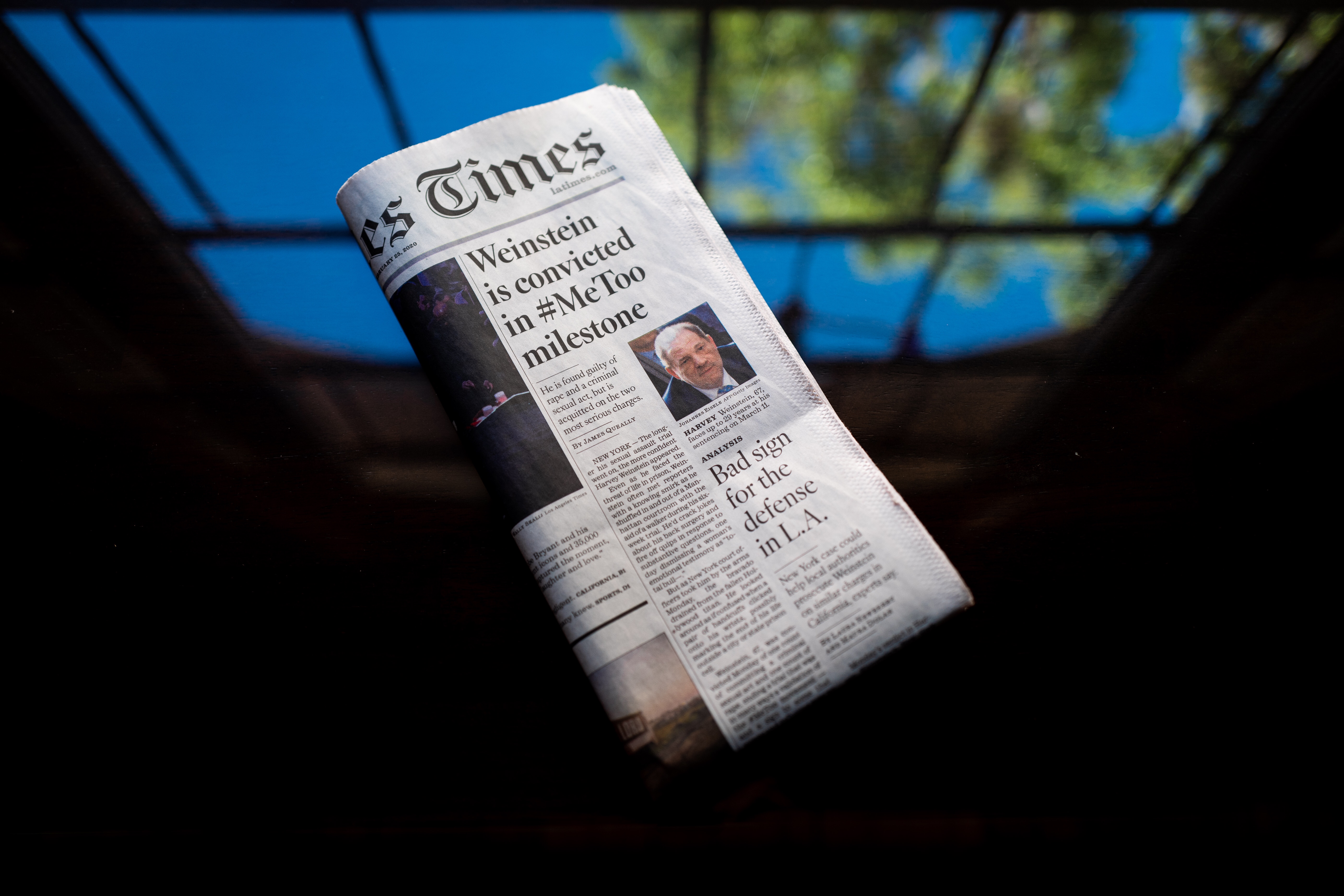
(The following is the first piece from my new Substack newsletter #MeToo CONFIDENTIAL which I’m posting here on 50lux because I’m currently in the mood for some system redundancy. Hope you all enjoy and please forgive me if this isn’t your cup of tea or, if it is, bring your self over to metoo.substack.com and enjoy your tea there with me!)
As the long overdue Summer of 2021 Time’s Up reckoning continues with CEO Tina Tchen deservedly following the embattled organization’s board chair Roberta Kaplan down Resignation Lane, I’d like to start off my very first #MeToo CONFIDENTIAL Substack newsletter with something I wrote over two and a half years ago.
“The Great Pretenders
The entertainment industry’s awards season has arrived in earnest and the January 6th Golden Globes brought up some concerns I’ve had since last year’s telecast.
The first is that Hollywood hates #MeToo and the pretty pony it rode in on. The second is that Time’s Up was and is Hollywood’s attempt to create its own social justice hashtag phenomenon, once again coming from its own ranks, but this time a viral movement the industry can both take credit for and, more importantly, control entirely by limiting its focus.
Yes it must be said. Time’s Up accomplishes great things connecting victims of workplace sexual misconduct with legal representation around the country. But that’s really the point of Time’s Up. The “around the country” part. Meaning far from Hollywood, where Time’s Up was founded with entertainment industry money by entertainment industry lawyers.
Think of Time’s Up as Hollywood’s carbon tax. Do undeniably good works in Kentucky and Louisiana to garner good will from women’s groups and the public in order to deflect scrutiny from its own industry where historically rampant workplace sexual misconduct ignited the #MeToo revolution in 2017.
It’s my opinion that Time’s Up represents a small optically correct self-serving pseudo-step in the right direction that puts many sincere and committed women in a position of being used by the prevailing powers of their various industries to appropriate the energy and hunger for change that gave birth to and drives the #MeToo movement.
How else do you explain the Golden Globes telecast? How do you explain an industry that has, over and over again down through the decades, memorialized most every conscience-wrenching moment in the history of our nation’s onward march towards a more civil and just society, choosing to forego any mention at all of #MeToo, what the Los Angeles Times called the ‘most significant’ social justice movement in modern history?
How do you explain a global phenomenon exploding off the Twitter account of one of Hollywood’s own, actress Alyssa Milano, taking the world into what has been referred to as the #MeToo era, and then juxtapose that with the person who triggered it all sitting quietly in the ballroom of the Beverly Hilton, given not a moment nor a mention on stage, her contribution to the forward progress of the entire species, as well as her presence in the industry she has worked in her entire life, all, completely and abjectly, ignored?
Alyssa Milano has advocated for the Equal Rights Amendment in the halls of congress and made her activist presence known by placing herself before cameras on a host of bedrock liberal issues from animal rights to gun control reform to more humane treatment of migrants at the border as well as being a leading voice in the push back against any perceived encroachment on the public’s right to vote.
She speaks out daily from her Twitter account and in public appearances and has been recognized for her efforts by being honored by organizations such as the ACLU and GLAAD. A brief bio accompanying her recent op-ed in the Washington Post states that Ms. Milano is “the founder of #NoRA, focused on counteracting the influence of the gun lobby in the American political system.”
But it was #MeToo that placed the former child star in the pages of TIME Magazine along with the other famous faces who came forward before, during, and after the Harvey Weinstein scandal broke in October of 2017.
And it was Ms. Milano’s tweeting of the idea that brought her, along with victims’ advocate Tarana Burke, to their present status as social justice icons at the forefront of a movement the impact of which will continue to grip the public conversation around sexual misconduct for years to come.
If Hollywood truly embraced #MeToo and what it represents in terms of progress for victims of sexual misconduct in workplaces everywhere and the effort to curtail a future wherein countless more victims will face the same abhorrent behaviors in pursuit of careers in its own industry, then one year out that industry would have certainly, at the very least, found time in a three-hour telecast to mention the person whose tweet and celebrity activism set off #MeToo.
At best we might have seen an appropriately emotional and uplifting video montage highlighting the social justice sea-change the #MeToo hashtag movement had brought worldwide and the role the now unstoppable member of its own acting/activist community played in using the celebrity Hollywood afforded her to help make it all happen.
But underestimating the willingness and the power of Hollywood to influence and control the #MeToo narrative and thus defend itself against the corrective efforts of something born from a desire to curtail sexual abuse in its own workplace is to overlook the greatest threat to #MeToo that it will likely ever face: The massive entertainment and media empire the hashtag phenomenon helped bring to a reckoning can easily absorb the principle voices of the movement and by doing so control both its focus and its targets.
So instead of any mention of #MeToo at the Golden Globes, what we saw were Time’s Up pins. And Alyssa Milano would be afforded only one brief instant on television as the camera cut to her sitting docile and unbothered in the audience, seemingly happy just to have been invited.
From the moment I first heard the words ‘Times Up’ on the stage at last year’s Golden Globes ceremony, I found the timing dubious and the wording and focus of the movement to be suspect. That something might be offered up as an alternative to #MeToo, however, and so quickly after the hashtag phenomenon’s explosion into a global conversation around sexual misconduct in Hollywood, was not a surprise to me at all.
Hollywood had no control over #MeToo and #MeToo was wreaking havoc on Hollywood. What the industry needed above all at that precise moment was a catchy hashtag movement of its own but one that was subject to its own influence. Hollywood has always been in the business of cultural appropriation. From political movements to the most important American roots music to teen trends in everything from dancing and new waves in street style, Hollywood’s creativity in turning such culturally important moments into massive profits is unprecedented in the annals of American business.”
(Yes, there was more to this piece and yes, you would want to see it. But no, I don’t want that kind of heat yet so I’ll stop right there.)
After #MeToo exploded in October of 2017, the rapidly approaching awards show season, beginning with the Golden Globes on January 6th, was Hollywood’s best chance to quickly rehabilitate its reputation with the public. They took the opportunity that very early January telecast afforded them and made damage control gold from it. It was a brilliant scheme, the imagery was perfect, and no entity in recorded human history is better at creating an image and selling it to the public than Hollywood.
I know now that I wasn’t alone in cringing every time I heard “Time’s Up” during that telecast. Maybe it was because I’d been anticipating that Hollywood would try to somehow offset #MeToo by finding a way to appropriate the public call for change the hashtag phenom had triggered. But I couldn’t have dreamed up anything as diabolically brilliant as Time’s Up. In one fell swoop Hollywood created a viral hashtag movement of its own, but one with which it could obscure its true motives beneath the subterfuge of also having established an organization of women lawyers who truly did good works on behalf of powerless sexual misconduct victims badly in need of legal representation.
Of course, we now know that that’s not all Time’s Up was doing. But, as it turns out, you really can only fool some of the people, some of the time. And you can only undermine the efforts of women to seek redress against sexual misconduct in their workplaces for so long before the patterns become clear and those very women would begin to expose the darker purposes of Time’s Up.
So Hollywood won great favor with women’s and victim advocacy groups for Time’s Up helping those in places far from Hollywood or anywhere else the most powerful abusers in America lurk. On that end they certainly kept up the payments on their carbon tax. But what would they be getting away with in return? What toxic behaviors by powerful men would be covered up and permitted to go on damaging the lives of women? What did Time’s Up not want anyone to see?
How would the dirty end of the carbon tax deal play out in the real lives of women who’d experienced sexual misconduct in entertainment industry workplaces or in the vast political ecosystems that we now know would be near and dear to the hearts of those behind Time’s Up, and the organization of entertainment industry lawyers and Democratic Party operatives who were making the decisions at Time’s Up Now and the Time’s Up Legal Defense Fund?
Well, we’re hearing what that all looked like in the stories coming now from many sources, most famously Enough is Enough: An Open Letter from Survivors to TIME’S UP + National Women’s Law Center | by Alison Turkos | Aug, 2021 | Medium calling out Time’s Up for its many failings. The letter was co-signed by nearly 150 survivors including 17 obviously exasperated current and former Time’s Up clients and staffers.
The letter opens with the charge that Time’s Up has abandoned those it was supposed to be helping, saying the organization instead has been “working with our abusers in the shadows.” Of course it has.
“There is a consistent pattern of behavior where the decision-makers at TIME’S UP continue to align themselves with abusers at the expense of survivors. TIME’S UP should be ashamed.”
Later, the otherwise brilliant and brave letter makes this assertion.
“TIME’S UP and the TIME’S UP Legal Defense Fund were founded and funded to be visionary organizations meant to provide three-dimensional support to victims and survivors as we navigate the legal system and the public eye. TIME’S UP and TIME’S UP Legal Defense Fund were built to advocate for those who make the bold decision to hold our abusers accountable.”
I’m sorry, Ms. Turkos, but that’s just not true. It’s my most firm belief that Time’s Up was founded for the reasons laid out in this piece by me here in 2021 and, as I’ve shown, my suspicions about the organization go back as far as the moment I first heard those two words on the 2018 Golden Globes stage.
I’m certainly not the only one who believes these things about the nefarious intent that inspired the creation of Time’s Up. You can be sure of that. And I don’t believe Time’s Up has lost its way. What I do believe is that thanks to you and the many women who are bravely standing up now telling of their experiences trying to find support and justice through Time’s Up, the duplicitous scam this organization always was is finally being exposed for what it is.
The first direct and damaging hit landed by the press on Time’s Up came back in April in The Daily Beast’s Insiders Say #MeToo Group Time’s Up Has Lost Its Way (thedailybeast.com) by Emily Shugerman. Ms. Shugerman’s article opened the Pandora’s box of what was actually going on at Time’s Up. (Now former) Time’s Up CEO Tina Tchen is quoted above the body of the article by a source as admitting in a staff meeting, “We have always been an organization of wealthy and powerful people,” Tchen said, according to the source. “That is what Time’s Up is.”
Well what does THAT look like, Tina? We might all have been wondering before we even began reading the piece. Shugerman does not waste our time, describing Tchen herself as having conducted a “whisper campaign” against the documentary film On The Record that detailed sexual assaults perpetrated by hip hop and fashion mogul Russell Simmons. Tchen is said to have told staffers that the producers of the film were “not good people.”
But Tchen might have hastened her own departure from the Time’s Up stage when she shared that sentiment with one of the absolutely last individuals on earth she should have, Drew Dixon, the music producer whose experiences with Simmons function as the documentary’s main story line.
“Tina Tchen said to me on the phone the night Oprah backed out of the film, ‘The filmmakers are bad people’ and when I disagreed with her she said, ‘You have to trust me on this,’” the survivor said. “She implied that Time’s Up would support me as a survivor, but only if I backed away from the film.”
The article adds the following note about the survivor quoted here, who has given permission for me to identify her as Ms. Dixon.
“The survivor spoke to The Daily Beast on the record, but later asked for her name to be withheld after a founding member of Time’s Up sent an email lashing out at her for participating in this story.”
(So let me add a note of my own here. Unless I’m given express permission to use a name I’m going to treat any survivor I allude to here on #MeToo CONFIDENTIAL as if they too might be a potential target of emails lashing out at them for having their names appear on my newsletter. And so for that reason I won’t be, by and large, using survivor’s names here. There will certainly be exceptions as I feel they are warranted such as in the case of very public persons or those who I have decided must be called out for any of the many problems associated with the current state of #MeToo. But if anyone recognizes themselves by way of their story being told here and wishes that their actual names should appear then please drop me a line and I’ll rewrite those sections to positively ID you.)
Caught Up
Last Saturday night, on Twitter, peddling her latest piece on the troubles at Time’s Up, New York Times reporter Jodi Kantor, who won a Pulitzer exposing Harvey Weinstein, the rapist whose decades long reign of terror in Hollywood was ended by the women he’d assaulted speaking out to Kantor and her partner Meghan Twohey, as well as The New Yorker’s Ronan Farrow, got her own reputation entangled in Time’s Up’s problems, partly for when she used a superlative to describe a statement by Time’s Up co-founder Shonda Rhimes regarding her organization’s current troubles. Kantor called Rhimes’s comment one of the most forceful quotes she’s ever published in her career as a journalist.
That tweet, and the glossing over tone of the article itself, angered many on Twitter.
So I’d like to end my first piece here on #MeToo CONFIDENTIAL with a superlative statement of my own for Ms. Kantor. Here it is.
From the moment it was conceived of in some industry law firm or top agency’s executive suite, to its disingenuous launching at the 2018 awards shows, right up until this very moment, there has NEVER been a more deliberate betrayal of a social justice movement than what Time’s Up perpetrated against the women in Hollywood, in politics, and doubtless elsewhere who tried to fight back against their powerful abusers by daring to come forward and simply say, #MeToo.
Postscript:
Make no mistake, the forced resignations of CEO Tina Tchen and board chair Roberta Kaplan from their leadership positions at Time’s Up is a great victory for women everywhere and survivors of sexual misconduct in particular. That it was a collective unified expression by survivors saying Enough is Enough that ultimately drove both Tchen and Kaplan out is a graphic demonstration of the true power that exists when large numbers of women, or anyone else, speaking as one, demand better from an organization that is supposed to be operating on their behalf.
This victory belongs to those women who rose up and demanded accountability and that there should be serious consequences for those responsible for their betrayal at Time’s Up.
But if anyone believes that the intrinsic nature of what Time’s Up is and the fundamental reasons it was founded are things that have or can be changed by simply replacing its current leadership, I would caution that such an outcome is extremely unlikely.
What is much more likely, in my opinion, is that those who continue to place their faith in Time’s Up will inevitably find themselves right back where they were just a few days ago with this organization, facing the same crushing disappointments as it continues to undermine survivors seeking support and justice by way of its promised assistance.
Because I don’t believe that Time’s Up was created for the purpose of doing what it purports itself to have been created to do. In fact, I believe the opposite. I believe that Time’s Up was created as a diversion from the infinitely more potent #MeToo movement. That its true purpose was to dazzle and distract the public and women’s rights advocates’ attentions alike away from #MeToo by accomplishing truly good works, far from its bases of power, for women who badly needed the legal help Time’s Up could provide them. But all while acting, as one survivor put it, as a spider’s web to attract and capture and ultimately frustrate others who turned to the organization seeking support and justice after facing abuse at the hands of the powerful and well connected.
These are the things I believe. But they only scratch at the surface of what I’m going to be writing about here on my new Substack newsletter.
Please subscribe if you don’t want to miss any future pieces by me and rest assured they will be arriving here and in your inboxes very soon.
Coming next week: The Great Pretenders Part II: Nexus of Evil
Doesn’t that sound like fun? You don’t want to miss it!
db
Next →

























All images shot with M6 TTL w/ 50mm f1.4 Summilux, M7 w/ 35mm f2 Summicron.


 50'Lux